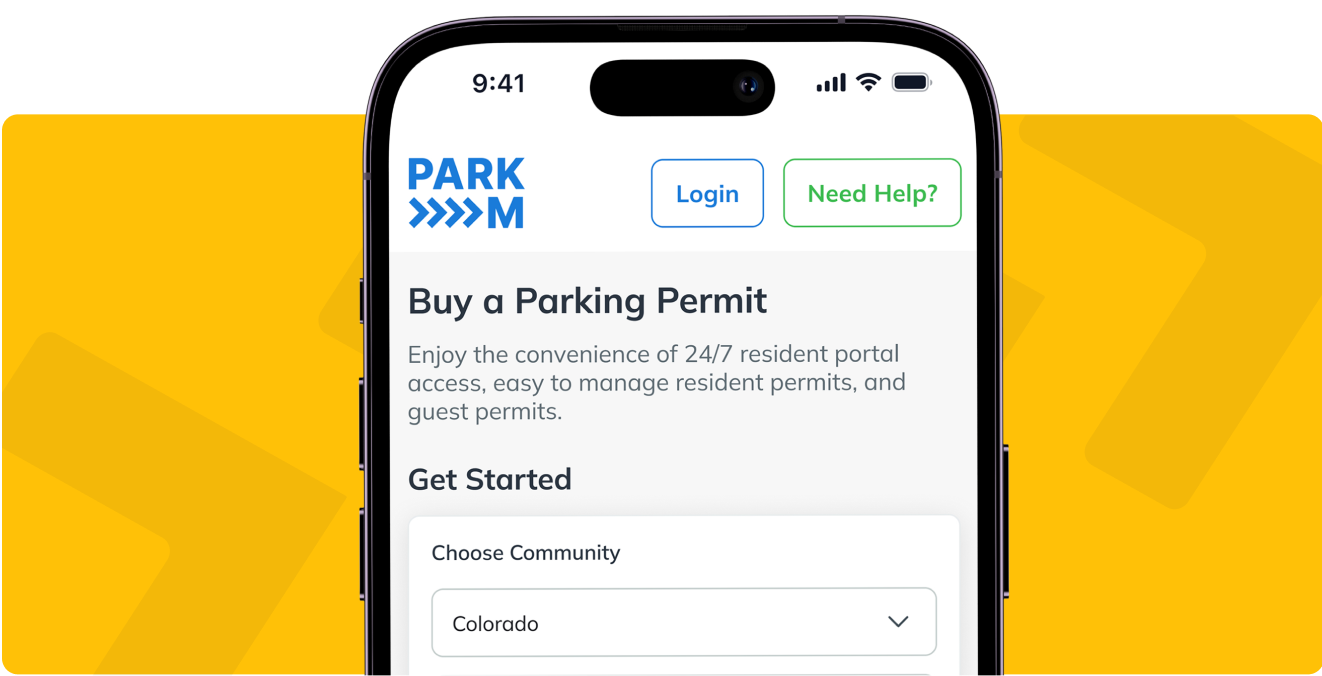
To manage apartment parking, someone has to decide who parks where, write clearrules that can be checked against the lot,, and register every resident and guest vehicle to a unit. Then cap guest parking, enforce in the same order every time (warnings first, then a tow), keep the permit list matched to your rent roll, and execute every change in small steps.
That’s seven jobs. Most parking lots that feel out of control are missing one or two, not all seven.
One property manager described their old system on a call with our team: “The window clings suck. They don’t stick. People put them in the wrong spots. The Sharpie wears off.”
When nobody can read the permit, the rules behind it stop working too, and the complaints land on the property manager’s desk.
These seven jobs are the same at a 120-unit garden community and across a regional portfolio. Only the number of lots or parking spaces changes. Below, you’ll get each job description in a few lines, who owns it, and the ParkM guide that covers it in depth.
Key Takeaways
- Most parking problems trace back to one missing job: unclear spaces, rules nobody can check, a stale permit list, or unfair enforcement.
- Write rules your tow partner can verify by looking at the vehicle, and tell residents before you enforce them.
- Enforce in a fixed order: warning, final notice, then a tow. One or two tows, applied the same way to everyone, usually changes behavior across a community.
- Don’t change the rules mid-lease. Grandfather current residents through the end of their lease and roll changes out in steps.
What does managing apartment parking involve?
Seven different jobs, and each one has an owner. Your office owns the rules and the records. Your tow or boot partner owns what happens to the car. Residents own registering their own vehicles.
| The job | What “done well” looks like | Who owns it | Go deeper |
|---|---|---|---|
| 1. Decide who parks where | Every space is assigned, reserved, open, guest, or accessible, and the count matches your units | Your office | Parking shortages: 7 solutions |
| 2. Write the rules | Each rule can be checked by looking at the vehicle information | Your office | Apartment parking rules |
| 3. Register vehicles | Every plate is tied to a unit and a leaseholder | Residents, with your office | Stickers vs. digital permits |
| 4. Manage guests | Limits per unit, per night, and on consecutive nights | Your office sets them; residents and guests register | Stopping guest parking abuse |
| 5. Enforce | Warning, final notice, then tow, with a record each time | Your tow or boot partner, on your terms | Parking warning notices |
| 6. Keep the list current | Permits match the rent roll, and move-outs come off the list | Your office | Online parking permit systems |
| 7. Roll out changes | Residents hear about a change before it’s enforced | Your office | How grandfathering works |
Who gets to park where?
Start with the lot you actually have. Count every space by type, then compare that count with your units and the number of vehicles your lease allows per unit. If those numbers don’t line up, no rule will fix the lot.
Assigned spaces drift over time. A manager on one of our calls described residents “using their dedicated spot as a storage facility basically for an extra car,” then taking the open spaces everyone else depends on. Decide which spaces are assigned, which are reserved for a fee, which are open, and which belong to guests, and write it down.
Check your accessible spaces too. Giving an accessible space to a resident without a reason leaves no space for residents who need it.
Unassigned lots carry one more obligation. Federal guidance gives the example of a community with unassigned parking that has to assign an accessible space near a resident’s entrance when that resident’s disability calls for it (HUD and DOJ, Reasonable Accommodations Under the Fair Housing Act). Our guide to ADA compliance for parking lots covers the rest, and ADA.gov’s guide to restriping parking spaces lists the accessible space counts if you’re repainting.
If the count comes up short, read our guide to apartment parking shortages before anyone prices new construction.
Pro Tip: Count the lot twice, once mid-afternoon and once after 10 pm. The gap between the two counts is your overnight resident demand, and it’s the number your vehicle limits should be set on.
How do you write parking rules residents will follow?
Write each rule so it can be confirmed by looking at the vehicle, get every resident to acknowledge it in writing, and apply it to every vehicle the same way. A rule like “no parking in the fire lane” takes seconds to check. A rule like “no inoperable vehicles” starts an argument unless you define it, for example, flat tires, expired registration, or a car that hasn’t moved in a set number of days.
Keep the rules short enough that your leasing team can explain them at move-in. If a rule needs a paragraph of exceptions, it’ll be enforced unfairly.
For the three tests every rule has to pass, read apartment parking rules that hold up in a dispute. To put it in writing, start from our apartment parking policy template, which has 12 clauses you can adapt to your community.
How should residents register their vehicles?
Tie every vehicle to its license plate and a unit, not to a piece of plastic or paper. Stickers, hang tags, and window clings all fail in the same ways: they fall off, get passed between cars, fade, and cost your team hours to hand out and replace. When the plate is the permit, the list your tow partner checks at night is the same list your office sees during the day.
Cap vehicles per unit or per leaseholder, so a one-bedroom can’t hold five registered cars. If you’re still printing tags, see what parking permit stickers really cost your property before the next order.
Our guide to how an online parking permit system works, rule by rule covers registration, renewals, and after-hours guests. ParkM’s parking permit software turns each resident’s plate into the permit itself, with no app to download and no tag to print.
How do you keep guest parking for guests?
Set a limit per unit, a limit per night across the property, and a cap on consecutive nights, then let residents and guests register online at any hour. Without those three limits, guest spaces fill with residents’ second and third cars.
Watch the pattern, not just the night. When the same plate buys a guest permit every evening for weeks, that car usually belongs to an extra occupant the lease doesn’t list. That’s a leasing conversation, and your guest parking records are what start it.
How to stop guest parking abuse covers policies, registration, and mistakes to avoid. To see how per-unit, per-night, and consecutive-day limits are set up, look at ParkM’s guest parking management software.
What order should enforcement follow?
Follow the same order every time: tell residents the rules, give a warning, follow up with a final notice that clearly states the deadline to resolve the issue, and only then tow or boot. Skipping a step is how a tow turns into a dispute. Applying the steps unfairly is how a rule stops meaning anything.
You rarely need many tows. A ParkM team member described the usual pattern to a property manager on a call: warnings first, then one or two tows, because “that word gets out very quickly in the community.”
ParkM doesn’t tow. Your property agrees on the terms with the tow or boot company it chooses, and that partner acts on the permit list. Every warning and tow should leave a timestamped record, so a resident’s dispute can be looked up instead of your word against theirs.
- For the wording and timing of each step, read parking warning notices: 3 steps before a tow.
- For who does what between your office, your tow partner, and the resident, read who enforces parking at apartments.
- For signs, notice, and who may authorize a tow in your state, read towing from private property.
Pro Tip: Before the first night of enforcement, give your tow partner a no-tow list of staff, vendors, and contractor vehicles. It’s the cheapest way to avoid towing your own maintenance tech.
ParkM’s parking enforcement services page explains how your tow partner reads plates on a smartphone using license plate recognition (LPR), with no cameras or readers installed on your lot.
How do you keep the permit list accurate?
Match the permit list to your rent roll on a schedule, and remove a vehicle the day its resident moves out. A permit list goes stale fast. Residents move out and keep parking, roommates swap cars, and a declined card leaves your team unsure whether a permit is still active.
After an eviction, make sure the vehicle can’t simply be registered again. And decide in advance what happens when a recurring payment fails, so your office isn’t improvising at the front desk.
Read how the permit list stays accurate when residents move out and what happens when a recurring parking payment fails.
Can you charge for parking without upsetting current residents?
Yes, if you don’t change the deal mid-lease. The approach that works is grandfathering: current residents keep parking at no charge through the end of their lease, and new move-ins pay from day one. Nobody’s lease changes under them, and parking becomes a line on your income statement instead of a cost.
You set the price and the permit types. Explain the change in writing, well before it takes effect, and say what the revenue pays for.
Our guide to apartment parking fees and how grandfathering works walks through the notices, the order to send them in, and the questions residents ask.
How do you roll out a new parking program?
In steps, with residents told what’s changing before anything is enforced. Before Arden at Corinth (296 units, Texas) switched, its property manager summed up the old setup in one line: “It was disastrous.”
The team rolled the new program out in stages. In the property manager’s words: “It was done in steps instead of all at once.”
Parking is now covered at move-in, so new residents know the rules before they ever need a guest permit. Parking revenue has since helped pay for a community pool party. The full story is in the Arden at Corinth case study.
Expect a short adjustment period, and plan for it. Eusebio, the community manager at Park Place at Expo (Colorado), saw the same thing: “Like any new system, there was an adjustment period. Some long-term residents were hesitant at first, but once they experienced the benefits, the complaints faded.”
A rollout that tends to go smoothly looks like this:
- Announce the change in writing, with the date enforcement starts.
- Give residents a registration window before enforcement begins.
- Use warnings, not tows, for the first weeks after the window closes.
- Cover parking in every new lease signing from then on.
Pro Tip: Put the parking rules in your move-in packet and walk new residents through them when they sign. A rule they heard on day one is a rule they rarely argue about later.
If you’re weighing whether your team should run all of this itself, read in-house or outsourced parking management.
Where does ParkM fit in?
ParkM handles registration, guest limits, and records, while your property keeps the rules and its own tow partner.
- Residents and guests register online, at any hour, with no app to download.
- You set the rules: vehicle limits by unit or leaseholder, guest limits, and the permit types your community offers.
- Your tow or boot company enforces, reading plates with LPR on a phone.
- ParkM answers residents’ and guests’ permit questions by email and the contact form, 5 am to 9 pm MST every day, so those questions don’t land at your front desk.
- There’s no cost to the property. The people who park buy their permits, and part of that revenue goes back to the property.
- ParkM covers the cost of a wrongful tow, plus storage fees up to 24 hours.
For a regional manager, one login covers every property in the portfolio, so each lot is a click away rather than a separate account. To see your own rules set up, book a demo.
Common questions about apartment parking management
What’s the most common apartment parking mistake?
Enforcing the rules inconsistently across leaseholders.
If two residents break the same rule and only one of them has their car towed, residents stop believing the rules are fair. A written ladder (warning, last notice, tow) used on every vehicle fixes most of it. Our list of top parking policy mistakes covers the others.
What do you do when a resident keeps parking in someone else’s assigned space?
Follow your ladder. Warn first, then send a final notice with a deadline, then hand it to your tow partner under the terms your policy sets. Make sure your permit list shows which plate belongs to each assigned space, so your partner can tell at a glance whose space it is.
Is managing parking different for one community and a whole portfolio?
The jobs are the same. What changes is consistency: a portfolio needs the same rules, the same enforcement ladder, and the same records at every property, or residents and staff who move between communities will notice the difference. Write one policy, adapt it per property where your state requires, and review every lot the same way.
Fix one job at a time
You don’t need to rebuild everything at once. Look at the table above, find the job your team spends the most hours on this month, and start there. For most communities, it’s either the permit list or guest parking.
“I would absolutely recommend ParkM, especially to properties dealing with parking control or guest parking issues. Parking is under control, resident complaints have gone down, and we have an additional source of income each month. Plus, the customer service is amazing.”
Carrie Stallings, Community Manager, Arden at Corinth, TX
Book a demo and we’ll walk through the seven jobs using your lot, your rules, and your tow partner.