“That gray sedan hasn’t moved in three weeks.” Somebody on your team says it, and the next question is usually whether to call the tow company.
Don’t call yet. First, find out whose car it is. If the plate belongs to a current unit, you’re dealing with a resident and a lease conversation. If it belonged to a unit that has moved out, it’s an unfinished move-out. If it belongs to no unit at all, it’s an abandoned or unauthorized vehicle, and your state’s notice and waiting rules apply before it leaves your lot.
The order is the same at a 190-unit property and across a 40-community portfolio. By the end of this article, you’ll know how to tell an abandoned car from a parked one, how to remove it without a dispute, and what Texas, California, and Arizona laws say about abandoned vehicles on private property.
Quick Answer
To handle an abandoned vehicle at an apartment complex, check the plate against your vehicle-to-unit list before anything else. A car registered to a current unit is a lease issue for your office. A car tied to no unit gets documented, checked with police, given written notice, and removed through your enforcement partner once your state’s waiting period has passed.
Is it abandoned, or just parked?
A car that never moves isn’t automatically abandoned. Plenty of residents travel for work, deploy, spend a month with family, or own a second car they rarely drive. The signs that get your attention are real, but they only tell you where to look:
- Flat or missing tires, or a car sitting on blocks
- Dust, leaves, or pollen piled on the windshield
- Old notices still stuck to the glass
- An expired registration tag
- The same car, in the same space, on two lot checks a week or more apart
What settles it is the record. Once you search the plate, every one of these cars lands in one of three cases.
| What the plate search shows | What you’re looking at | Who handles it | First step |
|---|---|---|---|
| Registered to a current unit | A resident’s car, running or not | Your leasing office | Contact the resident and point to your lease |
| Registered to a unit that has moved out | A car left behind at move-out | Your leasing office | Cancel the permit and contact the former resident |
| Registered to no unit | An abandoned or unauthorized vehicle | Your office, then your enforcement partner | Document it and start the notice process |
Only the third row is the abandoned-vehicle case state laws have in mind. The first two start as conversations with people you already know.
Why does the record matter more than the car’s condition?
Because the worst outcome is towing a resident’s car as “abandoned”. A resident who comes home from a six-week work trip to an empty space and a storage bill will take it to your office, your regional manager, and probably a review site. A car’s condition can’t tell you who owns it. Your vehicle list can.
Here’s how that plays out. Say your maintenance leadflags a white pickup with two flat tires that hasn’t moved in months. Before anyone calls the tow company, your community manager searches the plate. It’s registered to unit 214, the permit is active, and the resident’s file shows a work assignment out of state. The fix is a phone call and a reminder about your operable-vehicle rule. Nobody tows anything, and nobody has a dispute to sort out.
That check only works if the list is current. A paper log or a spreadsheet from last spring won’t help your maintenance team much. He needs a list that ties every plate to a unit, and residents update their own vehicles.
Pro Tip: Make “search the plate” the first line of your abandoned-vehicle procedure, above “call the tow company”. Put it in writing so a new assistant manager follows the same order you do.
To see how a plate search works in practice, take a look at the property manager portal.
How do you remove an abandoned vehicle from your lot?
Once the plate search comes back with no unit, work through these six steps in order. Each one leaves a record you’ll want later.
- Photograph the car and log when you first saw it. Take date-stamped photos of the car, the plate, the space it’s in, and anything that shows it hasn’t moved. Write down the make, model, color, and the VIN if you can read it through the windshield. Some states ask for these details in the tow authorization.
- Search the plate again on the day you act. A resident may have registered the car since your first check. It takes a minute.
- Call your police non-emergency line. Ask whether the car has been reported stolen or is part of an investigation. If it has, the police take it from there, not your tow company.
- Leave a written notice on the car. Date it, say which rule the car breaks, and give a clear deadline for moving it. Keep a photo of the notice in place. Your lease, your posted signs, and your state’s rules determine what the notice must say and how long the deadline must be.
- Wait out the full period. Don’t shorten it because the space is in demand. Then check the car again, and photograph it again.
- Authorize the tow in writing through your enforcement partner. Your tow or boot company does the removal on the terms in your agreement. Keep the photos, the notice, your notes, and the authorization in one file for that plate.
Signs and tow authorization have their own rules in each state, set out in towing from private property. If you’re choosing or replacing a partner for this work, read what to look for in a tow company for apartments.
What do state laws say about abandoned vehicles on private property?
They differ a lot from state to state, and so does who’s allowed to remove the car. Some states give the property a direct route. Others hand an abandoned vehicle to law enforcement. Here’s what three of the larger multifamily states say, from the statutes themselves. It’s a starting point, not legal advice, so check the current text and talk to your attorney before you set a policy.
| State | What the statute says | Source |
|---|---|---|
| Texas | A vehicle that has stayed on private property without the consent of the owner or person in charge for more than 48 hours counts as abandoned. Police may take an abandoned vehicle into custody from public or private property. | Transportation Code 683.002(a)(3) and 683.011(a) |
| California | No one may abandon a vehicle on private property without the owner’s consent. A peace officer, or a city or county employee designated for the job, may remove a vehicle believed to be abandoned from private property. | Vehicle Code 22523(b) and 22669(a) |
| Arizona | A vehicle left unattended for 72 hours on public or private property is prima facie evidence of abandonment. | A.R.S. 28-4801 |
Two California details are worth knowing. A property can remove a car that’s missing a major part, such as the engine, wheels, tires, or windshield, after it notifies local traffic law enforcement and 24 hours have passed (Vehicle Code 22658(a)(3)). The written tow authorization must also name the vehicle (plate, VIN, make, and model), state why it’s being removed, and record when the car was first observed (22658(l)(1)(B)). That’s step 1 above, written into law. Our guide to California private property towing laws covers the rest.
In Texas, the 48-hour rule falls under abandoned motor vehicle law, which is a law enforcement process. A tow your community orders through its own partner still follows the state’s private parking rules on signs and notice.
If your community is in Colorado, Florida, Georgia, Utah, or anywhere else, check your state’s rules before you write a waiting period into your policy. Your state’s motor vehicle agency, your local police, and your attorney are the right places to start.
What if the car belongs to a resident and doesn’t run?
Then it’s a lease issue, not a towing issue. An inoperable car registered to a current unit belongs to someone on your rent roll, and your lease is the right tool.
Start with the wording. “Cars must be in running condition” invites an argument. “No vehicle with a flat or missing tire, or that can’t be driven, may stay in a space for more than 14 days” is easy for anyone to check. Our apartment parking rules guide shows how to write rules your team can confirm by looking at the car, and the apartment parking policy template has a clause you can adapt.
Then send the resident a dated written notice from your office with a deadline to repair or move the car. Most residents fix it once they know you’ve noticed. Keep the judgment call with your office, too. Your enforcement partner works from what it can verify at the vehicle, and “this car doesn’t run” isn’t something a driver can confirm at 2 am.
Can you tow a car for an expired registration?
Sometimes, and it depends on your state. An expired tag on a resident’s car is usually a lease item: send a dated notice and give the resident time to renew. Some states restrict towing from an apartment lot for an expired registration alone, and Texas is one of them. Our towing from private property guide covers the Texas rule.
If a car belongs to no unit and never moves, an expired tag is another sign it’s been left for good. Note it in your file with the date.
What about a car left behind after a move-out?
It’s a common case, and the record tells you about it first. A plate that’s still registered to a unit that moved out last month is a gap between your move-out checklist and your vehicle list.
Picture it. Kayla moves out on the 31st and leaves a silver sedan with a dead battery in her old space. Two weeks later, the new resident in that unit can’t park. The plate search shows the car is still registered to the unit under Kayla’s name. Your office ends her permit, emails her writes to her forwarding address with a dated deadline, and leaves a matching notice on the car. If she collects it, the file closes. If she doesn’t, the car now belongs to no unit, and you follow the six steps above.
Two things help here:
- Add “end the parking permit” to your move-out checklist, next to the keys and the forwarding address.
- Block the plate after an eviction, so the car can’t come back on a guest permit.
Some states also have separate rules for property a former resident leaves behind. Ask your attorney whether yours treats a vehicle that way.
Pro Tip: Compare your vehicle list against your current leases once a quarter, and again after a busy move-out season. Every leftover plate you catch on paper is one less car your team has to chase in the lot.
How does ParkM keep the record current?
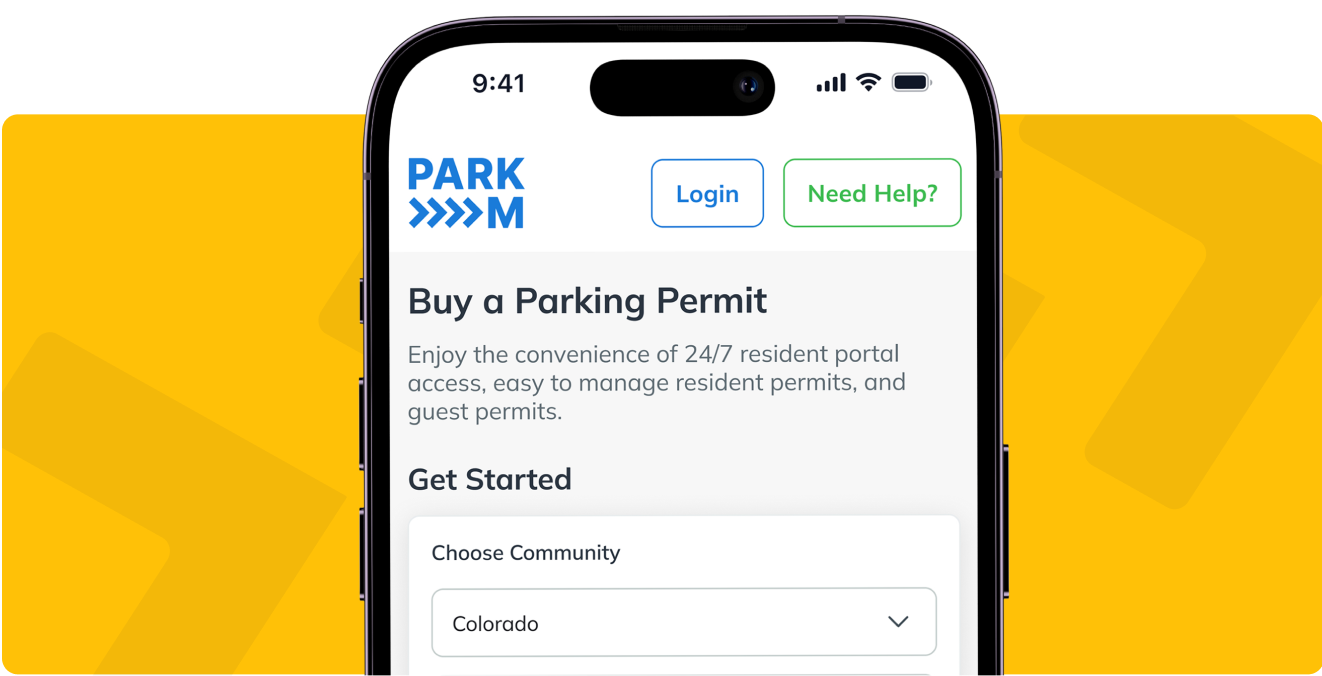
ParkM matches every resident’s license plate to a unit, so the plate is the permit. Residents register their own vehicles online, swap a car or cancel a permit at any time at no charge, and ParkM sends a text and email reminder before a permit runs out. That’s what keeps the list accurate without your team chasing it.
For an abandoned vehicle, that means:
- A plate search answers “whose car is this?” You can drill down by vehicle or by resident in the property manager portal.
- Abandoned vehicles, inoperable cars, and expired registrations stand out, and a car with no unit behind it shows up as exactly that.
- Your enforcement partner checks plates from a smartphone and can verify the last six digits of the VIN, and every enforcement action is timestamped.
- You can request a tow directly from the portal once your notice period has run.
ParkM isn’t your tow company. Your property sets the rules and the enforcement terms with its own partner, and ParkM keeps the record that partner works from. ParkM also covers the cost of a wrongful tow, plus storage fees up to 24 hours, under its no-bad-tow guarantee.
When a car turns out to be more than a parking problem, the record matters even more. Tina Pike (Property Manager, Sofi Belmar, Colorado) put it this way: “When an incident requires law-enforcement involvement, having vehicle information such as make, model, and license plate readily available can also be extremely helpful.”
To see how enforcement works with your own tow partner, visit parking enforcement services, or book a demo to see a plate search for yourself.
Questions property managers ask about abandoned vehicles
How long does a car have to sit before it counts as abandoned?
It depends on your state. In Texas, it’s more than 48 hours on private property without the owner’s consent (Transportation Code 683.002). In Arizona, 72 hours unattended is evidence of abandonment (A.R.S. 28-4801). Other states set their own periods, so check yours before you put a number in your policy.
Can an apartment complex tow an abandoned car?
Usually, yes, through a licensed tow company, under your posted rules and your state’s notice requirements. Check the plate first, call police if the car may be stolen, and keep a written record of every step.
Who do I call about an abandoned car in my apartment parking lot?
If you’re a resident, call your leasing office. If you’re the property manager, search the plate first, then call your police non-emergency line to rule out a stolen car, then work with your enforcement partner on the removal.
Can the police remove an abandoned car from private property?
In some states, yes. Texas lets law enforcement take an abandoned vehicle into custody from private property (Transportation Code 683.011), and California lets a peace officer or a designated city or county employee remove one (Vehicle Code 22669). Ask your local police how they handle it.
How do tow trucks know which cars to tow at an apartment complex?
They work from your rules and your permit list. With a digital permit system, your enforcement partner can check each plate against the list from a phone before acting, so a resident’s car with an active permit shows as allowed.
What should your abandoned-vehicle procedure start with?
An abandoned vehicle at an apartment complex is rarely a mystery once you search the plate. The record sorts it into a resident’s car, a move-out leftover, or a car that belongs to no one, and each has its own owner on your team. Document what you see, rule out a stolen car, give written notice, and wait out the period your state sets before your enforcement partner moves it.
The hard part is keeping the list current enough to trust. If yours lives in a spreadsheet, book a demo and look at a list where every plate already has a unit.