Parking Enforcement Services for Apartment Communities: Who Actually Does What
Key takeaways
- ParkM is the permit and visibility layer. It is not an enforcement company and not a tow company.
- The property sets the parking rules and holds its own agreement with its towing or booting partner. ParkM is not a party to that agreement.
- Your enforcement partner checks plates against the live permit list from a phone, so there is no camera, reader, or gate to install.
- Every enforcement action is timestamped and documented.
- ParkM costs the property nothing. There is no monthly billing to the property, and the vehicle owner pays.
Key takeaways
- ParkM is the permit and visibility layer. It is not an enforcement company and not a tow company.
- The property sets the parking rules and holds its own agreement with its towing or booting partner. ParkM is not a party to that agreement.
- Your enforcement partner checks plates against the live permit list from a phone, so there is no camera, reader, or gate to install.
- Every enforcement action is timestamped and documented.
- ParkM costs the property nothing. There is no monthly billing to the property, and the vehicle owner pays.

Apartment parking enforcement is three jobs, and most vendors describe it as one.
Search for parking enforcement services and you get two kinds of companies. Municipal enforcement departments, which write tickets on public streets and have nothing to do with your lot. And local patrol and towing firms, which will drive your lot after the office is closed and hook a car.
Neither of those is what a multifamily property manager is actually shopping for, and neither one describes what actually breaks in a private lot. Private property parking enforcement is three separate jobs.
Someone has to decide the rules: who may park, how many vehicles a unit gets, how long a guest may stay. someone has to know, at 2am, which plate in that lot is authorized and which is not. And someone has to move the vehicle.
The three jobs get talked about as one, which is how a property ends up towing a resident who paid. The middle job usually has no owner. Without it, the person making the call in the lot is a driver with a clipboard and a list that was printed on Tuesday.
“Are you enforcement, or do you replace our tow company?”
No on both counts, and it is one of the three questions ParkM hears most often before a first call.
ParkM does not employ tow trucks, does not employ patrol officers, and does not hold the agreement with the company that tows at your property. You hold that agreement, you set its terms, and you can end it or change.
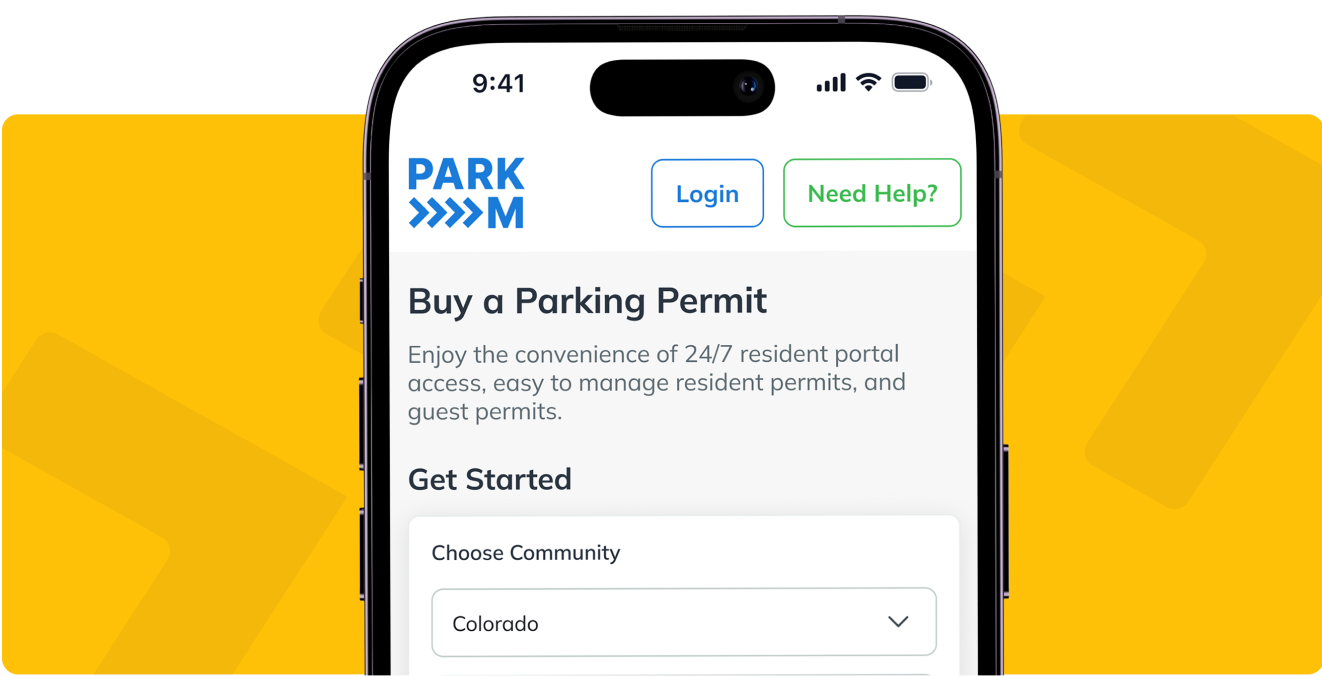
What ParkM does is the middle job. Residents and guests register a vehicle and buy a digital permit, the plate becomes the permit, and the permit is live the moment it is bought. Your enforcement partner then reads from that live list instead of from a printout.
The category rarely draws this line, so here it is. ParkM is parking enforcement software, not a parking enforcement company. It holds the record of who is allowed to be in your lot. It does not put anyone in your lot.
ParkM’s own description of the arrangement, on how ParkM works, is exact: “Your preferred towing or booting partner enforces using ParkM’s built-in 2-factor permit checks, so you can be sure every action is verified and documented.”
People often expect a fourth party here, a separate enforcement firm sitting between the property and the tow truck. There is not one. In this model the enforcement partner and the towing or booting company are the same firm, doing both jobs, on terms you set with them directly.
The property, ParkM, and your enforcement partner
This is the table to forward to whoever has to approve the change.
Read the right column and one thing stands out: ParkM holds no row that ends in a vehicle moving. That is deliberate, and it settles the question above.
| The job | Who holds it |
|---|---|
| Setting the parking rules: who may park, how many vehicles per unit, how long a guest may stay | The property |
| Choosing the towing or booting company, and agreeing terms with it | The property |
| Posting the signage the property’s state requires before a vehicle can be towed | The property |
| Registering vehicles and issuing digital permits to residents and guests | ParkM |
| Telling the enforcement partner which plate is authorized, in real time | ParkM |
| Taking resident and guest emails about permits | ParkM |
| Recording every enforcement action with a timestamp | ParkM and The enforcement partner |
| Patrolling the lot and checking plates against the permit list | The enforcement partner |
| Deciding that a specific vehicle meets the property’s rules for a tow | The enforcement partner, under the terms the property set |
| Hooking and moving the vehicle | The enforcement partner |
Read the right column and one thing stands out: ParkM holds no row that ends in a vehicle moving. That is deliberate, and it settles the question above.
What happens before a vehicle gets towed
The sequence matters more than the software, because this is where a wrongful tow is either prevented or created.
- The resident or guest registers. ParkM captures the license plate and the last six digits of the VIN. No vehicle registration document is asked for or uploaded.
- The permit goes live immediately. There is no overnight sync and no window in which a resident has paid but is not yet safe.
- The enforcement partner patrols and reads plates. License plate recognition (LPR) is built into the enforcement app and runs on the partner’s own phone, so the check happens from the vehicle rather than on foot with a flashlight. No camera, reader, or gate is installed at the property.
- The plate comes back as authorized or not. The list is live and current as of the last permit purchased.
- An unauthorized vehicle is verified a second time. The partner checks the last six of the VIN against the vehicle itself when the plate does not appear in the system before anything happens to it. That second look is what catches a misread plate, an I read as a 1 or an O read as a 0, and it is why the check is described as two-step rather than as a plate scan.
- Warnings usually come first. ParkM’s recommended sequence is warning notices before any vehicle is towed, and the portal flags a resident who has collected two or more. Whether your property escalates from a warning to a tow, and how fast, is agreed between you and your enforcement partner.
- Every action is timestamped and documented. When a resident comes to the leasing office angry, the record of what was checked, when, and by whom already exists, and it exists whether the outcome was a warning or a tow.
Press us on step 5, because it stands behind ParkM’s own commitment: ParkM covers the cost if a vehicle is wrongly towed and up to 24 hours of storage fees. How that works, and how a property makes a claim, is set out on the no bad tow guarantee.
If you want the longer version of what plate reading changes in a lot, how LPR parking enforcement changes lot oversightwalks through it, and the whole capability list sits on ParkM’s parking management features.
What changes for the tow company you already use
Almost nothing about the relationship. They keep their trucks, their dispatch, their rates, and their agreement with you. ParkM does not take a position between you and them, and does not ask you to switch.
What changes is the check they run before hooking a vehicle. Instead of matching a car against a list the office sent over, the driver reads the plate on their own phone and gets a clear answer per vehicle. Training your enforcement partner on the app is part of launch, and ParkM runs it.
The other thing that changes is what they can see. The enforcement portal shows vehicle and permit data only. Your enforcement partner does not get resident names, unit numbers, lease information, or anything else from your systems.
If your community has a public road running through it, or shares a lot with the grocery store next door, the same boundary applies: what may be towed, and from where, is set by state law, by your lease, and by your agreement with your tow partner. The permit list does not change any of it.
What if we do not have a tow company yet?
Then ParkM will help you find one, and it still will not be ParkM. From the property manager FAQs: “If towing enforcement is not currently set up at your property, please reach out to us at support@ParkM.com. We will assist you in finding a suitable company from our list of preferred vendors to meet your specific needs.”
The introduction is a referral. The agreement is still yours, with them.
What the property still decides
Property managers rarely hesitate here over the tow company. They hesitate because handing parking to a vendor sounds like handing over control of parking. The opposite is closer to true, because a rule nobody can check in the dark is not really a rule.
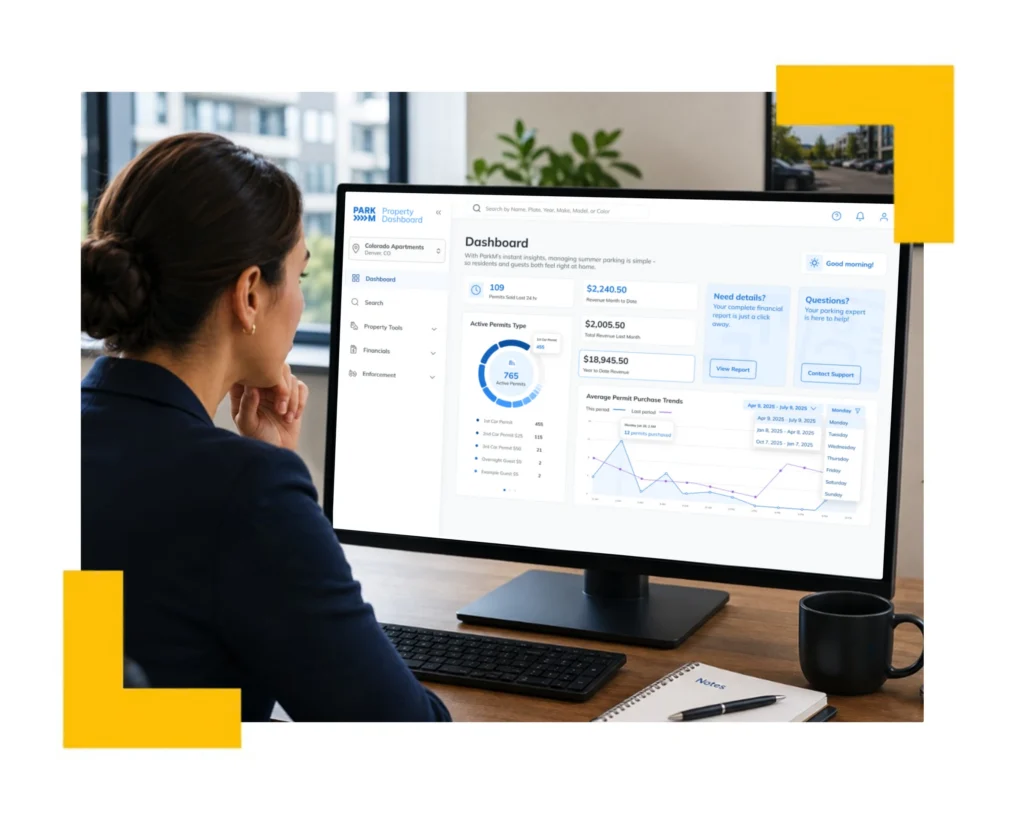
Everything below stays with you, and is changed by you, from the property manager portal:
- Which permit types exist: resident, second vehicle, guest, reserved, public.
- How many permits a unit or a leaseholder may hold.
- How many guest permits are allowed per night, per unit and across the whole property, and how many nights in a row a guest may stay.
- A no-tow list, for staff, vendors, and anyone else you name.
- Plate blocking, for a vehicle that should no longer be on the property at all.
- Whether a vehicle gets warned before it is considered for a tow at all, which you agree with your enforcement partner.
- What a permit costs, which the property sets rather than ParkM.
Permit types and permit limits can be adjusted at any time after the first 60 days, so a rule that turns out to be wrong for your community is a settings change, not a renegotiation.
ParkM’s own line for this is short: you set the rules, we make them stick.
Visitor Registration and Rule Enforcement

Visitor Registration and Rule Enforcement

Tow Notifications
Quickly address unauthorized parking with efficient tow notifications, maintaining the integrity and availability of parking spaces.
License Plate Reader (LPR) Integration
Utilize cutting-edge LPR technology for instant monitoring and verification of vehicles in your lot, enhancing enforcement efficiency and accuracy.
Visitor Registration and Rule Enforcement
Tow Notifications
Quickly address unauthorized parking with efficient tow notifications, maintaining the integrity and availability of parking spaces.
License Plate Reader (LPR) Integration
Utilize cutting-edge LPR technology for instant monitoring and verification of vehicles in your lot, enhancing enforcement efficiency and accuracy.

Who pays for parking enforcement services
The vehicle owner does.
ParkM is free to the property. There is no cost to the property and no monthly billing to the property, because the vehicle owner is the one who pays: the software is funded by the permits residents and guests buy. ParkM’s site puts it plainly on how ParkM works: “our application is completely free of charge for the property.”
Your arrangement with your towing or booting partner is separate and unchanged, and whatever you pay them today, you keep paying them, on the same terms.
Questions property managers ask about parking enforcement services
Does ParkM tow vehicles?
No. ParkM does not own tow trucks and does not employ drivers. Towing is carried out by the property’s own towing or booting partner, under the terms the property agreed with that company. ParkM’s role is to tell that partner which plates are authorized, and to record what happened.
Can we keep the tow company we already use?
Yes. ParkM works alongside the tow or boot company you already have rather than replacing it. Your partner is trained on the enforcement app as part of launch, and your agreement with them stays between the two of you.
Who decides whether a car gets towed?
The property sets the rules, and the enforcement partner applies them in the lot. The on-site team can also request a tow for a specific vehicle directly from the manager portal. ParkM does not make that call on either party’s behalf.
Does our enforcement partner need to buy equipment?
No. License plate recognition is built into the enforcement app and runs on a smartphone, so there is nothing to install at the property: no cameras, no readers, and no gate hardware.
What does our enforcement partner get to see?
Vehicle and permit data only. The enforcement portal shows which plates are authorized and which are not. It does not show resident names, unit numbers, or lease details.
Visitor Registration and Rule Enforcement
Visitor Registration and Rule Enforcement
Tow Notifications
Quickly address unauthorized parking with efficient tow notifications, maintaining the integrity and availability of parking spaces.
License Plate Reader (LPR) Integration
Utilize cutting-edge LPR technology for instant monitoring and verification of vehicles in your lot, enhancing enforcement efficiency and accuracy.
Visitor Registration and Rule Enforcement
Tow Notifications
Quickly address unauthorized parking with efficient tow notifications, maintaining the integrity and availability of parking spaces.
License Plate Reader (LPR) Integration
Utilize cutting-edge LPR technology for instant monitoring and verification of vehicles in your lot, enhancing enforcement efficiency and accuracy.
You keep the rules, and you keep your tow company
ParkM makes your rules checkable at 2am and puts a timestamped record behind every check. The decisions that were yours before are still yours afterward.
Two screens settle whether that is true at your community: what your tow partner sees on their phone in the lot, and what your on-site team sees in the portal the next morning. Book a demo and make us show you both.
Not there yet? Apartment parking management for property managers covers what ParkM handles day to day for an on-site team, and what causes unauthorized parking, and how to prevent it starts from the problem rather than from the product.