“Someone’s parked in my spot again.”
If your leasing office hears that every week, you’re not alone. Unauthorized parking is one of the most common complaints at apartment communities, and one of the most fixable. You stop it with four things working together: a written parking policy every resident has agreed to, a permit list that’s accurate in real time, regular checks of the lot, and enforcement your tow company applies the same way to every car, within your state’s rules.
Whether you run one community or a portfolio of them, the fix is the same. By the end of this article, you’ll know the six reasons unauthorized parking keeps coming back, what it’s costing your team, and the seven steps that get it under control.
Key takeaways
- Unauthorized parking is rarely about bad residents. It’s usually unclear rules, an out-of-date permit list, or enforcement that only happens after someone complains.
- More signs and sterner emails won’t fix it. Knowing who’s allowed to park where, right now, will.
- The communities that get it under control combine digital permits, quick guest registration, scheduled lot checks, and consistent enforcement through their tow partner.
- Every unauthorized car costs your team time, and repeated parking problems give residents a reason not to renew.
What counts as unauthorized parking at an apartment community?
Unauthorized parking is any vehicle on your property that doesn’t have permission to be in that space at that time.
It covers more ground than most onsite teams expect:
- A resident parked in someone else’s assigned or reserved spot
- A vehicle with an expired permit, or no permit at all
- A guest who stayed “one night” and never left
- A second or third vehicle that was never registered to the unit
- A non-resident using your lot as free overflow for a nearby business, school, or event
- An abandoned or inoperable vehicle taking up a space for weeks
- A resident using visitor parking to avoid paying for a garage or reserved space
That last one catches a lot of urban communities. Carla Panarelli, Property Manager at Aria on the Row in Massachusetts, put it this way: “Before ParkM, residents were using our visitor parking to avoid paying for garage parking, which meant our actual guests often had nowhere to park.”
Each of these looks different, but they have one thing in common. Nobody can quickly answer, “Is this car allowed to be here?”
Why does unauthorized parking keep happening?
1. Your permit list lives in a spreadsheet, or nowhere at all
A permit list in a shared drive, a paper log, or someone’s memory is out of date the day it’s made. Residents move out, guests overstay, and people change cars. A static list can’t keep up with a community that turns over every month.
2. Registering a guest takes too much effort
If guest parking means a phone call, a paper form, or a trip to the leasing office, residents skip it. That’s how “just for the weekend” turns into a car nobody can identify.
3. Enforcement only starts when someone complains
At most communities, the team finds out about unauthorized parking when a resident calls. By then, the problem has been going on long enough to make someone angry. You’re reacting, not managing.
4. Nothing happens when people ignore the rules
If unauthorized vehicles are never tagged or towed, the rules are optional. Residents notice quickly, and the problem grows.
5. The rules aren’t clear, or aren’t posted
Often it’s confusion, not defiance. Residents don’t know which spots are theirs, how long a guest can stay, or where to register a car.
6. Move-outs leave old permits active
A resident moves out, but their permit stays on the list. A former resident’s car, or a subletter’s, keeps parking in a space that now belongs to someone else. Without a permit system that expires or renews on its own, that gap can last for weeks.
What does unauthorized parking cost your property?
Unauthorized parking is a business problem, and it shows up in your staff hours and your renewals.
| Parking problem | What it costs the property |
|---|---|
| Cars in assigned or reserved spaces | Staff time fielding complaints and arranging tows |
| Guests who overstay | Office interruptions, frustrated residents, and sometimes an unauthorized occupant |
| An out-of-date permit list | Disputed tows and the hours it takes to sort them out |
| Residents parking in visitor spaces | Guests with nowhere to park, and lost revenue from paid spaces |
| No consistent enforcement | Residents who stop trusting the rules, and complaints that keep coming |
Parking is the one amenity residents use every day. A resident might go to the gym or pool a few times throughout the summer, but they park their car every single day. That gives parking more chances than almost anything else on your property to leave a bad impression.
Non-renewals are expensive. National Apartment Association research puts the cost of a single non-renewal at about $4,000, once you count unit turnover, marketing, and lost rent during vacancy. A lot that never feels under control is one more reason for a resident to leave.
There’s less room for error than there used to be. The NAA also reports that average parking ratios at apartment properties with 50 or more units fell from 1.62 spaces per unit in the 2000s to 1.46 in the current decade, the lowest since the 1960s. With fewer spaces per unit, every unauthorized car takes a space a paying resident needs.
Then there’s the staff time. Each complaint means someone answers a call or email, tries to identify the car, checks the policy, and follows up with the resident. Multiply that by every community in your portfolio and it’s one of the biggest avoidable drains on your team’s week.
How do you stop unauthorized parking? A seven-step plan
1. Write the parking policy down and get it signed
Your policy should say who can park, where, how many vehicles each unit gets, how long guests can stay, and what happens to a vehicle that breaks the rules. Put it in the lease or a signed addendum, so every resident has agreed to it before enforcement starts. If you’re reviewing an older policy, these common parking policy mistakes are a good checklist.
2. Post signs that meet your state’s regulatory rules
Signs tell everyone the rules apply, and in most states they’re required before you can tow. States set their own rules on what a tow-away sign says, where it goes, and how long it has to be up, so check yours before the first tow. Our guide to towing from private property covers what to confirm first.
Pro Tip: Walk every entrance before you launch new rules. If a driver can reach a parking space without passing a sign, you’ve found a spot where a tow could be disputed.
3. Replace stickers and spreadsheets with a live permit list
The fix for an out-of-date list is a digital one that updates the moment a resident registers, changes cars, or cancels. With digital permits, the license plate is the permit, so there’s no sticker to peel off and pass to a friend, and no hang tag to forget. Set permit limits by unit or by leaseholder so extra vehicles don’t quietly fill the lot.
4. Make guest registration quick, and set limits
The easier it is to register a guest, the more residents will do it. Let residents and their guests register a vehicle from a phone, at any hour, without calling the office. Then set a daily cap on guest permits and a limit on consecutive days, so a long-term guest shows up as a pattern your team can follow up on. More on this in our post on how to stop guest parking abuse.
Pro Tip: A guest who registers night after night may be living with the resident. Treat the consecutive-day limit as an early warning for a lease conversation, not only as a parking rule.
5. Check the lot on a schedule, not after a complaint
Don’t wait for a resident to call. Schedule regular lot checks during times when problems are more frequent, usually evenings and overnight. With license plate recognition (LPR), the person checking scans plates with a phone and sees right away which vehicles are registered, instead of walking the lot with a printed list.
6. Enforce the same way every time
Selective enforcement wears down trust faster than anything else. If cars are only towed when a resident complains loudly, everyone learns the rules are optional.
Start with warnings, so residents have a fair chance to register. Then enforce. A tow or two early on usually gets the message across, because word travels fast in a community. Keep a no-tow list for staff, vendors, and anyone else you’ve cleared, so the wrong car never gets flagged. And make sure your enforcement partner works from your current permit list. If you’re choosing or reviewing one, read our guide to choosing a tow company for apartments.
7. Audit your permit list against your rent roll
Every few months, compare registered vehicles to your current units and leaseholders. You’ll find permits that belong to former residents, vehicles tied to people who aren’t on a lease, and units with more cars than your policy allows. If you manage several communities, look at the numbers side by side. Repeat problem units and recurring guest overstays are easy to miss one property at a time.
How do you roll out new parking rules without upsetting residents?
Changing the rules mid-lease is where most rollouts go wrong. Residents don’t expect perfection. They expect fairness.
Tell residents what’s changing, when, and why, before anything is enforced. Give them a registration window, and send a quick reminder to anyone who hasn’t signed up before it closes.
If your new program includes paid permits, consider grandfathering. ParkM recommends enrolling existing residents for free to start, so the rules don’t change for anyone mid-lease. Each property decides. Some choose to skip grandfathering to start earning revenue right away.
Expect a short adjustment period. Eusebio, Community Manager at Park Place at Expo in Colorado, saw it firsthand: “Some long-term residents were hesitant at first, but once they experienced the benefits, the complaints faded.”
How ParkM helps you stop unauthorized parking
Everything above works better when your permit list, guest registration, and enforcement records live in one place.
That’s what ParkM does.
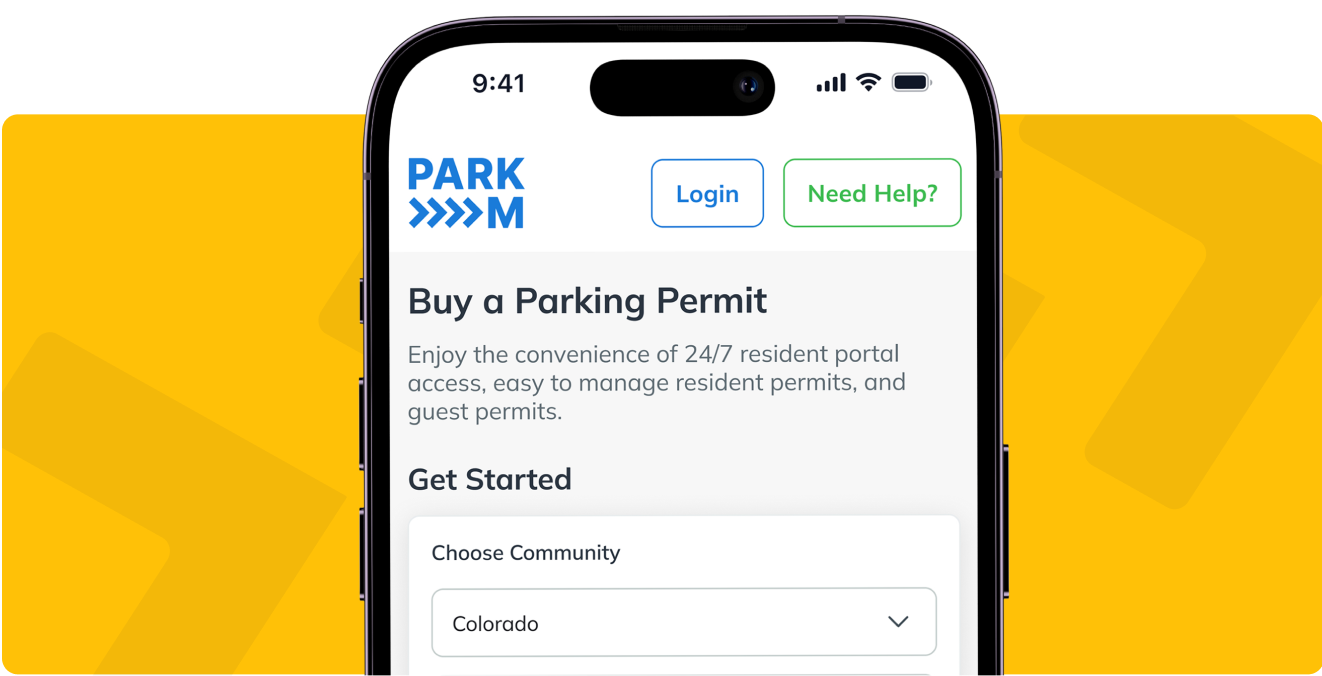
- The license plate is the permit. Residents and guests register from their phones, 24/7, with no app to download. Your list is accurate the moment someone registers, changes cars, or cancels.
- You set the rules. Choose permit types, limits by unit or leaseholder, daily guest caps, and consecutive-day limits.
- Your enforcement partner scans plates with a phone. LPR is built into ParkM’s enforcement app, with no cameras or equipment to install. Your partner can see the plate and the last six digits of the VIN on file.
- Every enforcement action is timestamped and documented, so your team has a record if a resident disputes a tow. And ParkM covers the cost of a wrongful tow, plus storage fees up to 24 hours, under the no bad tow guarantee.
- You see everything from one login. The property manager portal shows active permits, vehicles, and enforcement history, flags residents with three or more warnings, and switches between communities in your portfolio.
- ParkM takes resident and guest support calls, so parking questions stop landing in your leasing office.
ParkM isn’t your tow company, and it doesn’t replace the one you have. You keep your rules and your enforcement partner. ParkM gives them an accurate, real-time answer to “Is this car allowed to be here?”
Here’s the part your owners will like: ParkM doesn’t add a line to your budget. Residents and guests pay for their own permits, so you get a better-run lot without a new expense. Ten standard ParkM parking signs are included at launch, too.
Eusebio described what changed at Park Place at Expo: “We were also spending hours every day manually tagging vehicles, which took up nearly half of my workday and still wasn’t solving the problem.” Since switching, he says, “Residents have started respecting the parking rules, and the parking lot is much better controlled.”
Questions property managers ask about unauthorized parking
Can you tow an unauthorized car right away?
It depends on your state and your signage. Most states require posted tow-away signs that meet specific rules before a vehicle can be towed from private property, and some add notice requirements. Confirm your state’s rules and your signs before the first tow, and keep your policy and permit list current so every tow is backed by a record.
What should you do when a resident parks in someone else’s assigned spot?
Treat it like any other violation. Check the permit list, contact the resident if you can identify the car, and follow your written policy: a warning first, then enforcement if it happens again. A digital permit tied to the license plate makes the first step take seconds instead of a phone tree.
How do you handle a guest who never seems to leave?
Set a limit on consecutive guest-permit days. When a guest keeps re-registering, follow up with the resident about whether that person should be on the lease. It’s a parking issue and a lease-compliance issue at the same time.
Do you need cameras to use license plate recognition?
No. With ParkM, LPR runs on your enforcement partner’s phone through the enforcement web app. There’s nothing to mount or wire on your property.
Does a parking program cost the property anything?
Not with ParkM. There’s no cost to the property and no monthly billing to the property. Residents and guests pay for their own permits, and the property sets the permit types and rules.
Get unauthorized parking under control
Unauthorized parking is a visibility problem, and it’s fixable. Clear rules, a permit list that’s accurate tonight, scheduled lot checks, and enforcement that treats every car the same will give your team its time back and give residents a lot they can count on.
Want to see how it works at your community? Book a demo and we’ll walk you through it.