Parkade and ParkM both take parking off your leasing team’s desk, but they manage different things. Parkade manages the individual parking space. Residents choose and pay for a specific spot in its app, each spot can carry its own price, and empty spots are sold to guests by the hour. ParkM manages who may park. The license plate is the permit, the property pays nothing, and your own tow partner enforces.
ParkM publishes this Parkade vs ParkM comparison, so read it with that in mind. Every Parkade detail below comes from Parkade’s own website as of September 2026, and the page says plainly where Parkade is the better choice.
For an asset manager, the question underneath is simple. Where will the parking income come from, and what will it cost the property to earn it?
Key takeaways
- Parkade is built around the space: per-spot pricing it calls “stadium pricing”, guest bookings on unleased spots, gate access from a phone, and syncing with Yardi, Entrata, and other property management systems.
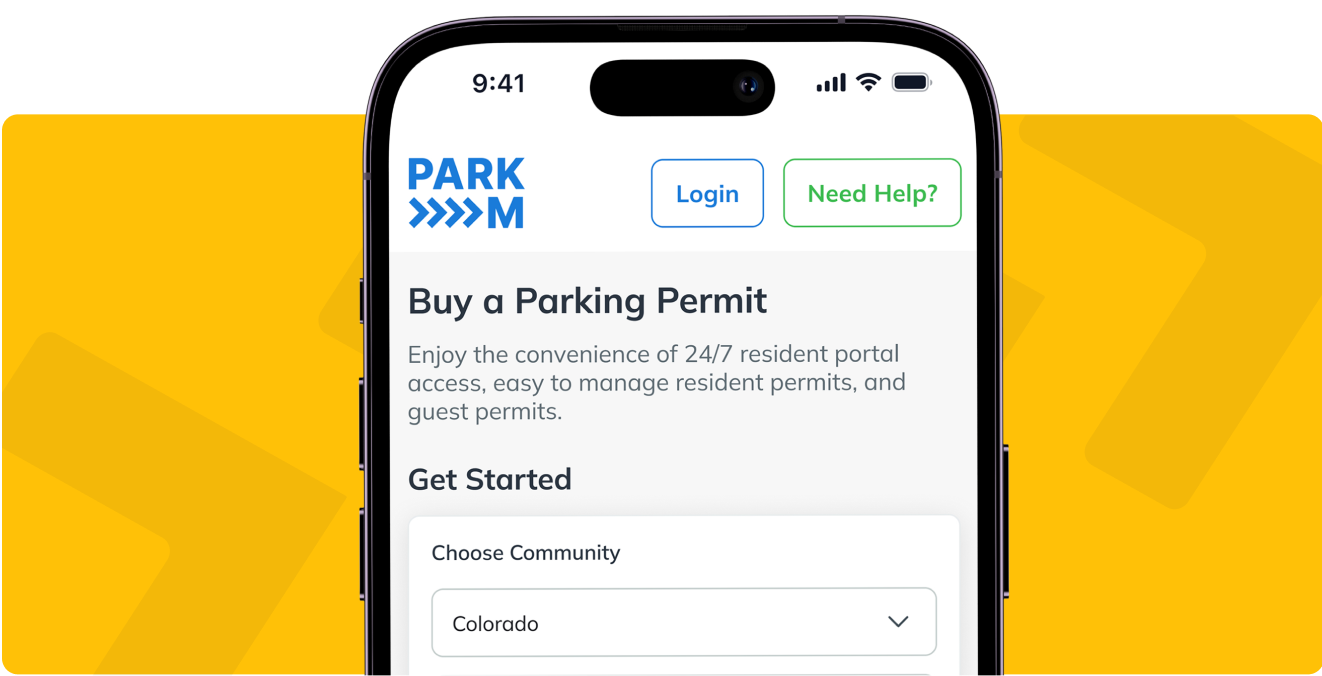
- ParkM is built around the permit. The license plate is the permit, residents and guests register online with no app, and there is no cost to the property because the vehicle owner pays.
- Parkade does not publish its pricing. ParkM’s model is public: no cost to the property and no monthly billing to it.
- ParkM covers the cost of a wrongful tow, plus storage fees up to 24 hours. None of the Parkade pages reviewed for this comparison describes a comparable guarantee.
- Parkade suits gated garages with assigned spaces, a live property management system sync, or a SOC 2 Type II requirement. ParkM suits open lots where parking has been free and the goal is order and income without a new cost line.
Parkade vs ParkM at a glance
| Parkade | ParkM | |
|---|---|---|
| What it manages | The individual space. Residents pick, pay for, and manage a specific spot | Permission to park. The license plate is the permit |
| Who pays the vendor | Not published | The vehicle owner, through permits. No cost to the property |
| How parking is priced | Each spot priced by location and quality, plus guest and event pricing | The property sets its permit types and prices |
| Guest parking | Residents book an open spot and send the guest a link | Residents or guests buy a guest permit online, within the limits the property sets |
| What residents use | The Parkade app, from the App Store or Google Play | A browser on any phone or computer. No app download |
| Gates | Opens swing, arm, and roll-up gates from the app | Permit-based, with no gate integration |
| Property management system | Yardi, Entrata, RealPage, Rent Manager, and more | No integration today. Residents register their own vehicles |
| Who enforces | Parkade’s support team works each report and calls for a tow when authorized. In-person Field Patrol is optional | Your own tow or boot company, checking plates in ParkM’s app |
| Wrongful tows | Not described on the pages reviewed | ParkM covers the cost of a wrongful tow, plus storage fees up to 24 hours |
| Resident and guest support | Parkade’s team, 24/7 | ParkM’s team, directly, not your leasing office |
| Residents already on a lease | Parkade’s own guidance recommends charging new residents or renewals first | Grandfathering is part of the launch |
| 100% tax credit properties | Not described | First Car Free |
| Security documentation | SOC 2 Type II, announced February 2026 | Not published. Ask for it |
| Condos and HOAs | A condo product for sharing deeded spots | Built for rental communities. Cannot bill an association |
Two different answers to “what are we managing?”
Parkade starts from the space. You decide the rules per leaseholder, for example one spot per resident, a second spot at a premium, and 10 hours of guest parking a month. Residents then choose a spot in the app, pay for it, and open the gate with their phone. Parkade’s own pages say its pricing model is unlocked by assigned parking, which tells you where it is strongest: a garage or lot where every space is numbered and some are worth more than others.
ParkM starts from the plate. The question it answers is whose car belongs on the property. The property sets the permit types (resident, second vehicle, guest, reserved), the limits per unit or leaseholder, and how many nights in a row a guest may park. Residents register their vehicles online, and your enforcement partner checks plates against that record. More on the guest side is on ParkM’s visitor parking permits page.
Picture two properties in the same portfolio.
The first is a 24-story tower with a gated garage, fewer spaces than units, and a waitlist. Its problem is scarcity. It needs to price its best spaces properly, sell the empty hours, and let residents through the gate without a fob. That is the problem Parkade’s product is built around.
The second is a 300-unit garden community with open surface parking that has always been free. By 9pm the guest spaces are full of residents’ second cars, and nobody at the office can say whose car is whose. There is no gate and no space worth pricing on its own. Its problem is permission, and that is the problem ParkM is built around.
If more of your portfolio looks like the second property, book a demo and ParkM will walk through it with your own unit count.
Where the parking revenue comes from
With Parkade: yield on the parking inventory
Parkade treats parking as inventory. Each long-term spot gets its own price by location and features, so the space by the elevator costs more than the one on the lowest level. Spots between leases become guest parking, booked by the hour or the day. Properties near a stadium or an events center can raise short-term prices on busy dates. Parkade’s Field Patrol service adds another line, which Parkade describes as “net new fine revenue”.
Parkade publishes 18 named case studies with figures. On its own website, Parkade reports a $130,000 lift in annual parking revenue at 903 Peachtree in Atlanta.
What Parkade does not publish is what it charges the property. Before you model the upside, get the cost side in writing: any subscription, any setup cost, and any share of resident or guest bookings.
With ParkM: a new income line with no cost line
ParkM costs the property nothing. There is no monthly billing to the property, because the vehicle owner who buys the permit pays for the program. ParkM shares that revenue with the property, and the property sets what a permit costs at its own community. Payouts arrive monthly, by check or ACH.
The income starts where there was none. In a lot that has always been free, any recurring parking income is new ancillary revenue, and at the property level it counts toward NOI like any other ancillary line. ParkM’s guide to how apartment communities generate revenue from parking covers the pricing method, and the link to asset value is covered in the role of parking management in property value.
Timing is the part to model honestly. If current residents are grandfathered, permit income builds as new residents move in and leases renew, not on launch day. Under a no-cost model a slow first quarter costs the property nothing.
Who enforces, and who pays when a tow goes wrong
Parkade takes on more of the enforcement itself. When a resident reports a car in their spot, Parkade assigns them a temporary spot, checks whether the car is in its system, and calls for a tow when authorized. Parkade’s team deals with the towing provider on the property’s behalf. Onsite teams can scan plates with Parkade Patrol in the app, and Field Patrol sends people to the property for 1-7 shifts a week. Parkade describes its approach as investigative: find the owner first, tow only when authorized.
ParkM does not patrol and does not tow. Your community keeps its own tow or boot company, which sets its terms with you directly and checks plates from a smartphone in ParkM’s app. If you have no partner, ParkM can suggest one from its preferred vendor list.
The check before a tow has two steps. When residents register, ParkM records the license plate and the last six characters of the VIN. Before towing, the tow operator compares those characters against the vehicle, which is there to catch a misread plate. Every enforcement action is timestamped. And ParkM covers the cost of a wrongful tow, plus storage fees up to 24 hours. That is a promise about who pays when a tow goes wrong, not a promise that one never will.
ParkM’s guide to towing from private property explains what a property should have in place before any tow.
What changes for your residents
With Parkade, residents get an invite link and use the Parkade app to pick a spot, pay, report a problem, book guest parking, and open the gate. Guests receive a link to add their vehicle, so they do not need the app. With ParkM, there is no app to download for anyone. Residents register online, swap vehicles, and cancel a permit at any time with no cancellation fee. They get email and text reminders before a permit expires.
Both vendors take residents’ parking questions off your front desk. Parkade advertises 24/7 coverage. ParkM handles resident and guest support directly, so questions about a permit or a charge go to ParkM rather than to your leasing office.
On current residents, the two companies agree more than they differ. Parkade’s own guide to moving from free to paid parking recommends charging new residents or renewals first, and describes a customer that kept current residents free for as long as they lived there. ParkM builds the same idea into its launch as grandfathering. The property chooses the shape: free until each lease renews, or free for as long as that resident lives there. A dedicated launch coordinator runs the rollout with pre-written resident communications, and grandfathered residents still register their vehicles, so the lot is fully visible from the first day. How ParkM works sets out the steps.
When Parkade is the better choice
When Parkade announced a $10 million Series A in May 2025, it said it had customers in 23 states. For some properties it is the right call.
- Your parking is a gated garage with assigned spaces, and pricing each space is the point.
- Parking is scarce, there is a waitlist, and you want to sell unleased spots to guests by the hour or raise prices on event dates.
- You need a live property management system sync, so parking starts at move-in and gate access ends at move-out. Parkade names Yardi, Entrata, RealPage, and Rent Manager.
- Your procurement team requires a SOC 2 Type II report.
- You want the vendor to run enforcement end to end, including in-person patrols.
- You need a resident support line that is staffed around the clock.
- You manage a condo building where owners want to share deeded spaces.
When ParkM is the better choice
- Your parking is an open lot, and the real problem is knowing whose car belongs there.
- Parking has always been free, and you want income from it without adding a cost line to the budget.
- You want current residents grandfathered, with the vendor running the launch and the resident communications.
- You want to keep your own tow company, and you want the vendor to cover the cost of a wrongful tow.
- You would rather residents and guests never download an app.
- You run a 100% tax credit property. Those properties cannot charge residents to park one vehicle on site, so ParkM’s First Car Free model makes the first resident vehicle free and runs on guest parking and, if the property chooses, additional resident vehicles.
- You manage several communities and want one login across them, with leasing staff working in the portal without seeing the financials.
The reasoning behind ParkM’s model is on why property managers choose ParkM, and the full feature list is on the ParkM benefits page.
What to ask both before you decide
Put the same questions to Parkade and to ParkM, and ask for the answers in writing.
| Ask | Why it matters to NOI |
|---|---|
| What does the property pay, in year one and after, including any share of resident or guest bookings? | Only one of these two publishes its model. A share of bookings is a cost even when there is no invoice |
| Which parking income stays with the property, and how often is it paid out? | Gross parking revenue and the property’s share of it are different numbers |
| If a vehicle is towed that should not have been, who pays the tow and the storage? | A wrongful tow is the complaint residents remember, and its cost has to land with someone |
| How are residents already on a lease treated on launch day? | This decides how fast income builds and how many complaints the office takes |
| What happens at move-in and move-out, and who updates the record? | A live sync and a self-registration model put that work in different places |
| What security documentation can you send our procurement team? | For an ownership group this is often the first gate, before price |
Frequently asked questions
What is the difference between Parkade and ParkM?
Parkade manages individual parking spaces. Residents choose and pay for a specific spot in its app, spots are priced by location, and unleased spots are sold to guests. ParkM manages permission to park. The license plate is the permit, residents and guests register online with no app, the property pays nothing, and the property’s own tow partner enforces.
How much does Parkade cost?
Parkade does not publish its pricing. Its website offers a demo and a sales form rather than a price list. Ask for a written quote for your unit count that includes everything the property would pay, so you can compare it with a model that has no cost to the property.
Does ParkM cost the property anything?
No. There is no cost to the property and no monthly billing to it. Residents and guests pay for their permits, ParkM is paid out of that revenue, and ParkM shares it with the property. The property sets the permit prices at its own community.
Does ParkM integrate with Yardi or Entrata?
No. ParkM does not integrate with a property management system today. Residents register their own vehicles and buy their own permits, so your team is not re-entering resident data, and ParkM can reconcile registered vehicles against your rent roll on request. If a live sync is a requirement, Parkade offers one.
Does Parkade or ParkM tow cars?
ParkM is not a tow company, and Parkade’s pages describe calling for a tow rather than towing. Parkade’s support team works each report and calls for a tow when authorized, dealing with the towing provider for the property. With ParkM, your own tow or boot partner decides and acts, after checking the plate and the last six characters of the VIN. ParkM covers the cost of a wrongful tow, plus storage fees up to 24 hours.
See both models against your own numbers
The fastest way to settle Parkade vs ParkM is with your own community. Book a demo, bring your Parkade quote if you have one, and ParkM will walk through the same property with no cost to the property, your current residents grandfathered, and your own tow partner kept. Customer stories are on ParkM’s page for property managers.
Last reviewed September 2026. Details about Parkade are taken from Parkade’s own website and can change.