Your permit list was right on the first of the month. By the tenth, three residents have new cars, a guest has started staying every night, one card has been declined, and nobody in the office is sure which version of the list your tow company is using.
An online parking permit system fixes that by keeping one list of license plates and applying your property’s rules at the moment something changes. The resident or guest makes the change, and the rules decide what’s allowed. Whether you run one community or a portfolio, the system is only as good as what those rules do on an ordinary night.
This guide follows one permit through a month: the first registration, an after-hours guest, a renewal, a declined card, a move-out, and a plate check in the lot. By the end, you’ll know what each step should do, which settings belong to your team, and six things to test in any parking vendor’s demo before you sign.
Quick Answer
An online parking permit system is a list of license plates registered to your property, plus the rules you set for who can buy which permit, how many can be purchased, and for how long. Residents and guests buy permits from a phone, the plate becomes the permit, and your enforcement partner checks plates against the live list.
What is an online parking permit system made of?
Three parts: a record, a set of rules, and a way to look up a car. Every vendor in the category has some version of each. The differences show up in how the rules behave.
| Part | What it holds or does | Who uses it |
|---|---|---|
| The record | Each permitted vehicle: the plate, the vehicle details, the unit or person it belongs to, the permit type, and whether it’s active | Residents and guests add to it; your team reads it |
| The rules | Which permit types exist, how many a unit can hold, how long a guest can stay, what each permit costs | Your team sets them |
| The lookup | A plate checked against the live record, with a dated history of every check and action | Your enforcement partner, and your team after the fact |
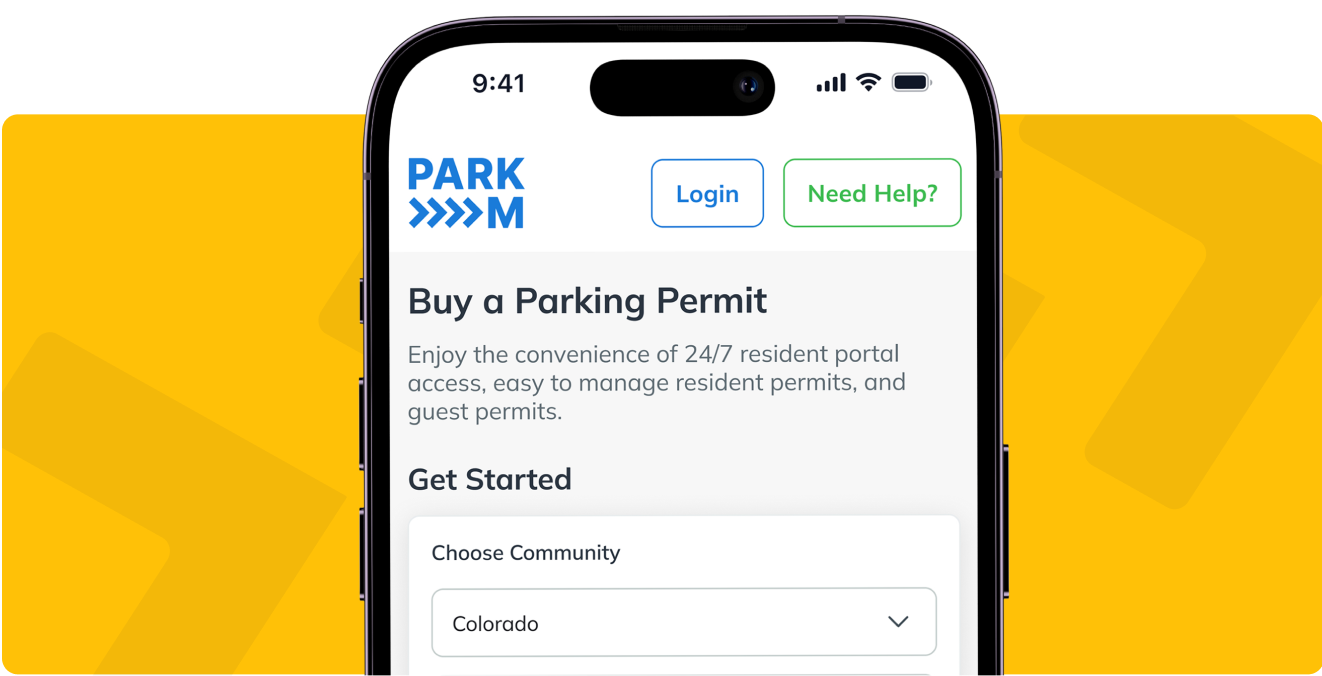
On ParkM, three portals share the record: residents and guests use parkm.app in a browser, your team uses the property manager portal, and your enforcement partner uses an enforcement app. Nobody downloads anything to buy a permit.
For what a virtual permit is and why communities leave stickers behind, see our guide to virtual parking permits. This guide stays with the rules.
What happens when a resident registers a car?
The resident enters the plate and vehicle details, picks the permit type they’re entitled to, and pays. The permit is live the moment it’s bought. On ParkM, registration also records the last six digits of the VIN, and no vehicle registration document is needed.
As an evaluator, look at what the system checks before it sells that permit:
- Is this unit already at its limit? You set limits by unit or by leaseholder. A two-bedroom with two people on the lease can be capped at two resident permits.
- Is this permit type open to this resident? You decide which types exist at your community: resident, second vehicle, guest, reserved, and public.
- Is this plate blocked? A plate you’ve blocked, for example after an eviction, simply can’t be registered again.
A limit doesn’t always have to mean “no”. Some communities charge more for a second or third vehicle instead of refusing it, nudging residents to park extra cars elsewhere without banning them outright. Either way, the system gives the same answer to every resident, so your leasing team isn’t making the call at the desk.
Picture a resident in a two-bedroom who brings home a third car on a Saturday. On a hang tag program, they ask the office on Monday, someone checks a binder, and the answer depends on who’s working. With the limit set in the system, the resident gets the answer at the moment of purchase, and nobody on your team has to deliver it.
Changes after that are edits the resident makes. A new car, a corrected plate, or a loaner gets updated in the “My Vehicles” section of their account, and the permit follows the plate they enter.
Pro Tip: At launch, ask your team to spot-check plates entered in the first week against the cars actually in the lot. A typed plate is only as accurate as the person typing it, and a letter O entered as a zero is easier to catch on day three than at a tow.
What happens when a guest shows up after the office closes?
The resident buys a guest permit for the plate, or the guest buys it directly. Neither needs your office, and both can do it at any hour. ParkM sends expiry reminders by email and text, and a guest can extend from the confirmation screen.
Guests are where a permit program either holds or leaks, so the guest rules carry the most weight:
- Guest permits per unit, so one apartment can’t absorb the visitor spaces.
- Consecutive nights for the same vehicle, so a guest permit can’t quietly become a second resident permit.
- A nightly cap across the property, first come, first served, if your visitor parking is small.
The interesting moment is when you hit the limit. On ParkM, a car that keeps buying guest permits night after night hits the consecutive-night limit, and the buyer is pointed to the leasing office. The plate then waits out a 24-hour break, or moves to a resident permit. That’s often the first sign that someone is living at the community without being on the lease.
Carla Panarelli, Property Manager at Aria on the Row in Massachusetts, put the result plainly: “Since implementing ParkM, one of the biggest shifts has been the reduction in resident complaints about guest parking.”
If guest parking is your pressure point, visitor parking permits covers the guest settings in more depth, and how to stop guest parking abuse covers the policy side.
Want to see what your guest rules would look like in the portal? Book a demo and bring your current guest policy.
What happens at renewal, and when a card is declined?
On ParkM, resident permits renew monthly on their own. There’s no annual renewal form and nobody on your team chasing it. ParkM reminds residents by email and text before a permit expires.
A declined card is the moment most paper programs never see. Online, the system handles it in the open:
- The resident gets a notice by email, text, or both, asking them to update their payment method.
- The resident fixes it from their phone. Nothing about it needs your office.
- If the payment still can’t be collected, the permit becomes invalid, and the plate drops off the authorized list. To keep parking, the resident buys a new permit.
That last step matters for enforcement. An unpaid permit doesn’t stay on the list your enforcement partner checks, so the list reflects who has actually paid, not who registered once. Payments are processed by Stripe, and they’re non-refundable once due.
Residents can cancel a permit at any time with no cancellation fee. That’s different from a refund. Say both in the resident notices at launch, so nobody hears “cancel anytime” as “money back”.
How does the permit list stay accurate when residents move out?
Through two routes: the resident cancels their own permit, and your team checks the list against your rent roll.
ParkM currently doesn’t connect to your property management system. ParkM imports your resident and unit data at launch; after that, residents register their own vehicles. We can help you make sure this registration list stays accurate through our audit service. .
An audit catches the cases a resident won’t report themselves:
- A vehicle still registered to a unit that’s been vacant for a month.
- More vehicles on a unit than there are people on the lease.
- A plate that belongs on your blocked list after an eviction.
Stephanie Coats, Property Manager at Lenox Cooper Apartments in Texas, described what that looks like after a few months: “We regularly review our parking records, and the information ParkM provides aligns with what we see internally, which gives us confidence that the program is working as intended.”
Pro Tip: Put a rent roll audit on the calendar quarterly, and run an extra one after any heavy move-out month. It takes your team a file export, and it’s a low-effort way to find unauthorized occupants before they become a lease problem.
What happens when your enforcement partner checks a plate?
Your enforcement partner drives the lot with the enforcement app open on a smartphone. License plate recognition (LPR) reads each plate and shows whether it’s authorized against the live list. No camera, gate, or reader needs to be installed at the property.
Because the list is live, a permit a guest bought at 11 pm already shows when the partner drives through at midnight. The partner can see the plate and the last six digits of the VIN on file. Every action is timestamped and documented, so the record of what was checked, when, and by whom exists before a resident walks into your office.
Three settings shape what happens next, and all three are yours:
- The no-tow list covers your staff, vendors, and anyone else you name.
- You decide whether a warning comes first. The property manager portal flags residents who’ve collected repeated warnings, so a pattern shows up before it becomes an argument.
- The terms of enforcement are agreed directly between your property and your own tow or boot company. ParkM doesn’t tow vehicles and doesn’t replace the company that does.
If a vehicle is towed incorrectly, ParkM covers the tow cost, plus storage fees up to 24 hours. The terms are on the no bad tow guarantee. For the details of the plate check itself, see LPR parking enforcement, and for who does what between you, ParkM and your partner, see parking enforcement services.
How do you test an online parking permit system in a demo?
Ask the vendor to run the moments above live, in front of you, instead of describing them. Six tests cover most of what goes wrong after launch:
- Register a third car on a unit capped at two. Watch what the resident sees, and whether the answer is a refusal or a higher price.
- Buy a guest permit at 11 pm as the guest, not the resident. Count the steps on a phone.
- Buy the same guest another night after the consecutive-night limit. See what the buyer is told, and what their way back is.
- Enter a plate with one wrong character, then fix it. Ask who can correct it, and how fast the change reaches the enforcement app.
- Buy a permit, then look up the plate in the enforcement view right away. It should already show as authorized, with no overnight sync.
- Pull the history for one plate. Every enforcement action should appear with a date and time, in a format you can show a resident.
A parking vendor who can run all six live follows through on what they say. One who needs to “follow up on that one” is telling you where your team will spend its evenings.
For the buying side of the decision, including how vendors get paid and which is right for your property, read how to choose parking permit software. For how the three portals fit together on ParkM, see the parking management system overview.
Questions property managers ask about online parking permit systems
Is a city’s online parking permit system the same thing?
It runs on the same idea: the plate as the permit. Cities such as Corvallis, Oregon, have moved street permits online this way. A city system is built around citations and public streets, though. An apartment system is built around units, leases, guests, and your own tow partner.
What does an online parking permit system cost the property?
On ParkM, nothing. The property pays nothing monthly. Residents and guests pay for their permits, and your community sets the price for each permit.
Do residents need an app or a printer?
No. Residents and guests buy and manage permits in a browser on a phone or computer, and nothing goes on the windshield.
How quickly can we switch from hang tags?
You need a unit directory and a launch date. Residents register during a free enrollment window before anyone is charged or any car is enforced, and how ParkM works covers the full rollout.
Where to go from here
An online parking permit system earns its place in the moments a paper list can’t handle: the third car, the guest who doesn’t leave, the card that fails, the plate that comes back red. If the rules handle those moments the same way every time, your team stops being the referee.
The rules stay yours, and so does your tow company. If you want to see the rest of what ParkM does for an onsite team, start with our page for property managers. If you’d rather run the six tests against your own lot, book a demo and bring your unit count and your current parking rules.