A parking permit sticker costs a property between about $0.32 and $6.00 per vehicle, depending on the material and how many you order. That number is the cheapest part of running a physical permit program, and it is the only part that shows up on an invoice.
The rest of the cost sits in your leasing office: the move-in who needs a tag the day they collect the keys, the resident who sold the car the tag is stuck to, the guest who arrives after hours, the cling that will not stick in July, and the argument that follows a tow nobody can document.
You have probably run this program for years and it mostly works, which is exactly why the reorder gets signed without a second look. Price it properly once, print costs and staff hours together, and the signature stops being automatic.
Key takeaways
- Published vendor pricing puts a windshield cling under $0.35 each in volume and a durable plastic hang tag between $3.69 and $6.00 each, before shipping and before a single hour of staff time.
- The print cost is the small number. The recurring cost is the office visit attached to every move-in, second vehicle, vehicle swap, lost tag, and guest.
- A physical permit system is attached to a windshield, not to a lease, which is why transfers, sold cars, and borrowed cars keep breaking it.
- A digital permit puts the license plate in the place the sticker used to sit, so the permit follows the resident and the record follows the permit.
- Grandfathering is what makes the switch survivable: existing residents enroll free until their lease renews and only new move-ins are charged, so the rules do not change mid-lease.
What a parking permit sticker actually costs
Start with the invoice, because it is checkable and because most managers have never priced it per year rather than per order.
Two vendors publish their full quantity grids, so these are real numbers rather than estimates. Both were checked on September 2, 2026.
| Permit type | Published price | Source |
|---|---|---|
| Parking decal, static cling, inside the windshield | $0.90 each at 50, $0.39 each at 500, $0.32 each at 1,500 | MyParkingPermit price grid |
| Parking decal, repositionable cling | $2.86 each at 50, $0.65 each at 500, $0.42 each at 1,500 | MyParkingPermit price grid |
| Parking hang tag, plastic, apartment permit | From $36.93 for 10 tags, about $3.69 each | MyParkingPermit apartment permits |
| Parking hang tag, plastic, rearview mirror | $6.00 each at 11 to 100, $5.00 each at 101 and up | Office Sign Company price grid |
Check those against your own last invoice rather than against a national average. Material, size, numbering, and reflectivity move the price more than quantity does, and your printer’s grid will differ.
The useful figure is not the unit price. It is the annual one.
Price the year, not the tag
Take your door count. Multiply by the number of vehicles you actually permit per unit, including second cars. Then add everything the initial print run does not cover:
- The move-ins you expect over the next 12 months, each needing a permit on arrival.
- Vehicle changes among residents who stay.
- Replacements for permits that are lost, faded, peeled, or left on a car that has been sold.
- Guest permits, if you issue physical ones, which turn over faster than anything else on the property.
- Overage, because ordering exactly what you counted means running short in month two.
Most properties order once and then order again sooner than planned. The reorder is where the program stops looking cheap, and it is a reasonable place to ask whether the program is still the right one.
Want the short version of the alternative before the detail? See how ParkM works.
The invoice is the small number. The hours are the big one.
Every physical permit creates an interaction, and every interaction lands in the leasing office during office hours.
Count the moments. A new resident moves in and needs a tag. A resident buys a second car. A resident sells the car the decal is stuck to and needs it transferred. A tag falls off the mirror in a car wash. The Sharpie number on the cling has worn to the point where nobody can read it. A resident moves from one unit to another and the tag number no longer matches the apartment. A resident moves out and the tag does not come back.
Then the guest half, which is worse, because guests do not keep office hours.
It is Friday at 7pm. Your resident’s parents have arrived for the weekend. The office closed at 5. The pass they need is in a drawer behind a locked door, so either the car sits unpermitted overnight or somebody on your team gets a phone call at home. Neither of those is a policy. They are both a workaround, and your team has been running one or the other for years.
Price it the same way you priced the tags. Pull one month of your leasing log, count the entries that exist only because a permit is a physical object, and multiply by 12. That number is yours, it is defensible in a budget conversation, and it is almost always larger than the printing cost it sits next to.
Where a physical permit fails
Six failures, and they are structural rather than a matter of staff diligence.
Start with what the permit is attached to. A sticker belongs to a windshield. Your authorization belongs to a lease. Those two come apart the first time a resident sells a car, borrows one, or drives the rental while theirs is in the shop, and nothing about the tag knows any of that happened.
Guest parking then needs an open office. Residents wait until someone is at the desk, which means they are already irritated by the time they ask. The pass they get has no expiration the lot can see and no limit the system enforces, so the weekend guest quietly becomes the resident’s second parking space.
Lost tags have no honest answer either. A resident says the tag was stolen. You cannot prove otherwise, and charging for a replacement makes you the villain over the price of one tag. So you reprint, and the number you thought was in circulation stops matching the actual number in circulation.
Changing the rules means reprinting the property. Adjust the permit types, the color scheme, or the year, and you are re-tagging every car on site and re-explaining the policy to every household at the same time. Most parking policies go unchanged for years after they stopped fitting the lot for exactly this reason.
Disputes then come down to paperwork. When a resident is towed and says they were never given a tag, the evidence is whatever your team wrote in a binder or a spreadsheet. The dispute lands in your office regardless of who made the call, and a physical permit program gives you very little to answer it with.
Underneath those five sits a sixth. The permits you issued drift away from the permits on the lot: numbers get reused, tags get shared between roommates, and old stock stays on cars that left last spring. Over a couple of years the drawer and the parking lot quietly disagree, and nobody knows by how much.
None of that is a criticism of how your property is run. It is what happens when the permit is a piece of plastic and the truth about who lives there changes every week.
Do we have to buy all our own signage?
No. Signs are what replace tags, and ParkM includes 10 parking signs carrying your property’s own QR code as part of setting the program up. Additional signage is deducted from what the property earns on permits rather than invoiced to the property.
The QR sign does the job the window cling used to do, from the other direction. A guest scans it where they parked and buys a permit on the spot. It never has to be reissued when a resident changes cars, and it does not run out.
Parking permit stickers vs a digital parking pass
| Physical sticker or hang tag | Digital permit | |
|---|---|---|
| What carries the permit | A decal or tag on the vehicle | The license plate already on the car |
| Issuing a new permit | Office visit, during office hours | Resident registers online, permit is live when it is purchased |
| A resident changes car | New tag, new number, manual record update | Resident updates the plate themselves |
| Guest arriving at 7pm on a Friday | Waits for the office to open | Guest or resident buys a permit at any hour |
| Lost or faded permit | Reprint, reissue, and a conversation about who lost it | Nothing to lose |
| Expiring permits | Nobody knows until enforcement finds it | Email and text reminders go out before expiry |
| Changing permit rules mid-lease | Reprint and re-tag the property | Change the settings, grandfather existing residents |
| Checking a car in the lot | Read a number through a windshield, on foot, at night | Read the plate |
| Cost to the property | Print run, shipping, reprints, and staff hours | No cost to the property, no monthly billing. The vehicle owner pays for the permit |
| Stopping | You already own the stock | No contract, 30 days notice |
The cost row in that table deserves a full sentence. ParkM is free to the property. There is no monthly bill to the property and no setup cost, because the permits residents and guests buy are what fund it. The property still sets its own permit prices.
What actually replaces the sticker
The plate that is already on the car becomes the permit. Nothing goes on the windshield and nothing goes in a drawer.
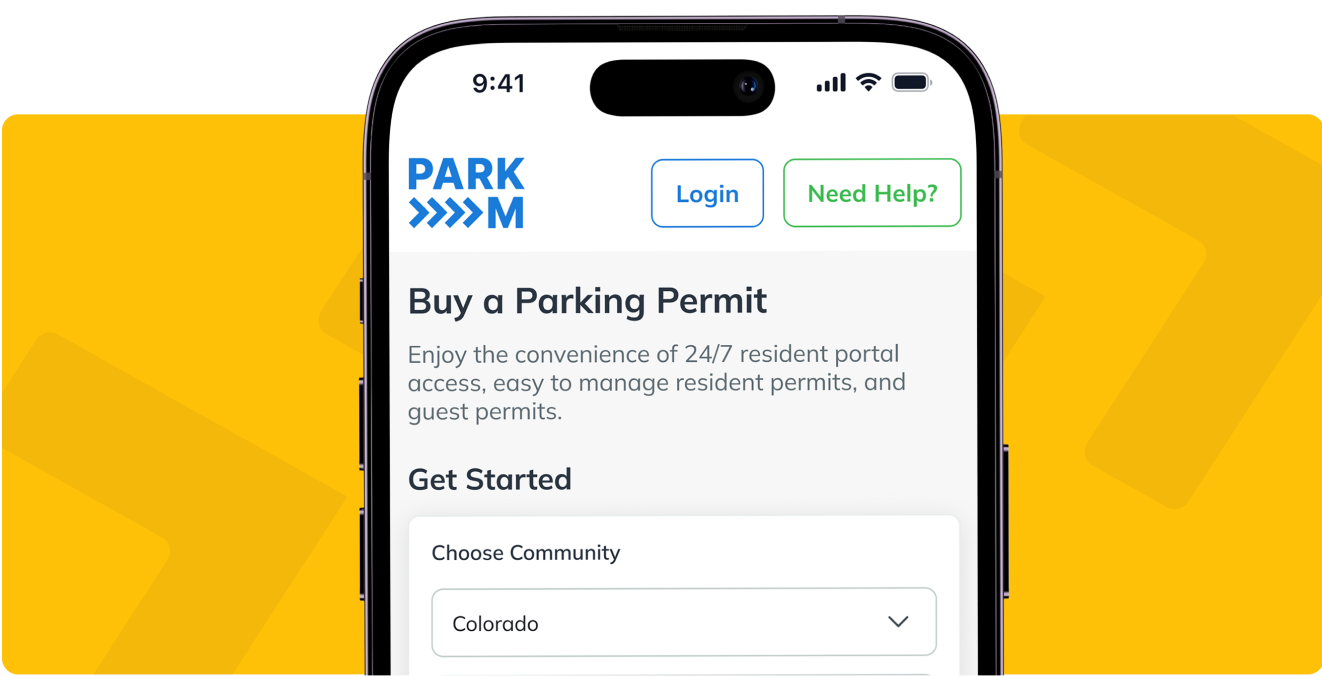
Residents register online from a phone or a computer, with nothing to install, and the permit is active the moment it is purchased. They can update a plate, swap a vehicle, or cancel a permit themselves at any time with no cancellation fee. Reminders go out by email and text before a permit expires, so a lapsed permit is something the resident sees coming rather than something enforcement finds.
Guests are self-service too. A resident can buy a permit for a visitor, or the visitor can buy their own, which is what removes the need for the leasing office to be available for permits 24/7. Guest and visitor parking is where most of those interruptions are concentrated today, so it is a sensible place to start.
You keep the policy. The property decides which permit types exist, how many permits a unit or a leaseholder can hold, how many guest permits are available, and how many nights in a row a guest can park. Those are settings rather than a print order, so you can change them in an afternoon instead of a quarter.
For the general explainer on how virtual permits work as a category, ParkM’s overview of virtual parking permits covers the mechanism in full, and the guide to moving off a manual system covers the sequence.
How do you switch without changing the rules mid-lease?
Nobody objects to this on technical grounds. A resident who signed a lease under one set of parking rules is entitled to be annoyed when the rules change underneath them.
Grandfathering is the answer. Existing residents enroll at no charge. Only new move-ins are charged. Nobody who already signed a lease sees a new line item appear on it.
That does two things for you. It lets you retire the physical permit without renegotiating with a full property at once, and it turns a property-wide announcement into a routine part of the move-in packet. The change reaches residents at the point they already expect new paperwork.
It also means the revenue side ramps slowly at a stabilized property with low turnover, and you should hear that from us before you model it yourself. Grandfathering makes the change easy and the ramp gradual. Both are true at the same time.
When reordering the stickers is still the right call
Not every property should switch, and a few should not.
- If parking is abundant, free, and nobody parks where they should not, there is nothing to permit and nothing residents would pay for. Keep the stickers or drop permits altogether.
- Single-family rentals, scattered-site portfolios, and commercial, retail, or municipal lots are outside what ParkM is built for. It is a multifamily product.
- Homeowner associations where owners hold deeded spaces are the honest edge case. ParkM is built around residents and guests buying their own permits, so an association that expects one monthly bill for the service is not the shape this fits today. There are workarounds worth discussing, and they are a conversation rather than a page.
- If your permit program genuinely costs your team no hours, the reorder is the cheaper option and you should approve it.
The test is a practical one: whether the hours and the disputes attached to stickers are worth what you are paying to keep them.
Before you approve the next print order
Three things are worth doing first, and all of them use your own numbers rather than anybody else’s.
Price the year rather than the tag. The print run is the visible cost and it is rarely the largest one.
Count the permit interactions in one month of your leasing log and multiply by 12. That figure belongs in the same budget conversation as the invoice.
Then decide what the permit should be attached to. A windshield changes hands. A lease does not, and a license plate is already on file with everyone who needs it.
Two pages carry the rest of the argument: why property managers move off physical permits and what ParkM does for property teams. When you want the arithmetic run against your own community, book a demo, door count and last permit invoice in hand.