For in-house vs outsourced parking management, most apartment communities do best with a split. Keep the decisions that shape your community: the rules, the permit prices, the exceptions, and your tow company. Hand off the work that fills your team’s day: permit paperwork, guest permits, and the resident calls.
You know which calls we mean.
“Someone’s parked in my spot again.” “My guest got a warning, and I registered her.” “I got a new car. What do I do now?”
Ask a property manager what parking costs and you’ll rarely hear a dollar figure. You’ll hear about the complaints all day long. Whether you run one community or a portfolio, here’s what in-house parking involves, what full outsourcing costs you, which parts to keep, and when outsourcing isn’t worth it.
Key takeaways
- In-house parking management is mostly front-desk work: issuing permits, keeping the vehicle list current, handling guests, and fielding complaints.
- Third-party parking management through a full-service operator removes that work, but it can also remove your say over the rules, the exceptions, and who gets towed.
- Most communities do best keeping the rules, prices, and tow company, and handing off the paperwork and the calls.
- ParkM runs on that split at no cost to the property, because the residents and guests who buy permits fund it. There’s no contract and 30 days notice. If parking isn’t costing you anything, you probably don’t need it.
What does managing apartment parking in-house involve?
Managing parking in-house means your onsite team runs the whole program, and most of it lands at the leasing desk as interruptions rather than as a line in anyone’s job description.
The job usually includes:
- Handing out stickers or hang tags at move-in, and replacing them every time a resident changes cars.
- Updating the vehicle list your tow company checks against.
- Issuing guest passes, leaving guests who arrive after the office closes with no way to get one.
- Walking the lot, or reviewing what the tow company flagged.
- Answering the resident whose car was towed, and the resident who wants a neighbor’s car towed.
It adds up. One manager, sizing up the job at her community, put the work her team wasn’t getting to at “10 to 12 hours a week.” That’s walking the lot every day, spotting the car that hasn’t moved in weeks, and tracking down its owner. To get your own number, this guide walks through how much time your team spends on parking management.
Carla Panarelli, Property Manager at Aria on the Row in Massachusetts, described the in-house version: “We didn’t have the time or resources to constantly monitor the lot, identify vehicles, contact residents, and coordinate towing.”
What changes when you outsource parking management?
Outsourcing parking can mean two different things. A full-service operator takes over the program, often including enforcement and sometimes the revenue. Parking software takes over the records but may leave the resident calls with you.
Neither one, on its own, answers what most property managers are asking: how do I get the calls off my desk without losing control of my lot?
Handing it all to an operator
In garages, an operator can lease the facility and pay rent on the building. Or it can run the garage for a management fee, as Cooperator News explains for co-op and condo garages. Propark’s comparison of in-house and outsourced parking operations says neither model is universally better.
For an apartment community, the trade-off is control. When an outside company runs enforcement, its procedures decide when a car gets a warning and when it gets towed. Your exceptions go through someone else’s process, like the resident whose permit lapsed the week her father was in the hospital. And if you already work with a tow company you trust, a full handoff can mean replacing it.
Buying software and keeping the calls
Parking software fixes the paperwork: plates go into a database, guests register online, and your tow company can check a plate from the lot. But if residents still call your office when they can’t log in or a renewal fails, you’ve changed the system and kept the interruptions.
Which parts of parking should stay with your property?
Keep the decisions. Your rules, prices, exceptions, and tow company are tied to your leases, your owners, and your local market. No outside company knows those as well as your team does.
That means your property should decide:
- Which permit types exist (resident, second vehicle, guest, reserved) and what each one costs.
- How many vehicles a unit or leaseholder can register.
- How many guest permits a resident can buy and how many nights a guest can stay in a row.
- Whether current residents pay at all, or park free until their lease ends.
- Which tow or boot company you work with, and on what terms.
- What happens when a vehicle is registered to someone living in your community who isn’t on the lease.
Pro Tip: Before you talk to any vendor, write down the three exceptions your team makes most often, such as a caregiver’s car or a moving truck for a weekend. Ask each vendor to show you how you’d set each one up, and who approves it.
Which parts are worth handing off?
Hand off the work that repeats. Registering vehicles, selling guest permits, sending renewal reminders, and answering “how do I” questions follow the same steps every time. They don’t need someone who knows your community’s history, and they pile up after hours, when your office is closed.
| Task | Who should own it | Why |
|---|---|---|
| Parking rules, permit types, and prices | Your property | Tied to your leases, owners, and market |
| Choosing the tow company and its terms | Your property | Your relationship and your liability |
| Exceptions and lease conversations | Your property | Someone who knows the resident is needed |
| Vehicle registration and car changes | Hand it off | Same steps every time, often after hours |
| Guest permits | Hand it off | Guests arrive when the office is closed |
| Renewal reminders and login problems | Hand it off | High volume, little judgment |
| Resident and guest support calls | Hand it off | The interruptions that eat the day |
| The record of authorized vehicles and enforcement actions | Kept by the system, readable by you | Disputes get settled from facts |
If a task needs judgment about your community, keep it. If it’s the same task for the 40th time this month, it belongs somewhere other than your front desk.
How does ParkM split the work?
ParkM divides the work along the same line.
- Your rules: you set the permit types, the limits by unit or leaseholder, the daily guest limits, and the consecutive-day restrictions. After the first 60 days, you can adjust pricing and permit types at any time.
- Your tow company: you set enforcement terms directly with your own tow or boot company, and ParkM’s software tells your enforcement partner which plates are authorized (parking enforcement services shows how those jobs are divided). No partner yet? ParkM can refer you to a preferred vendor from its list, and here’s how to choose a tow company for apartments.
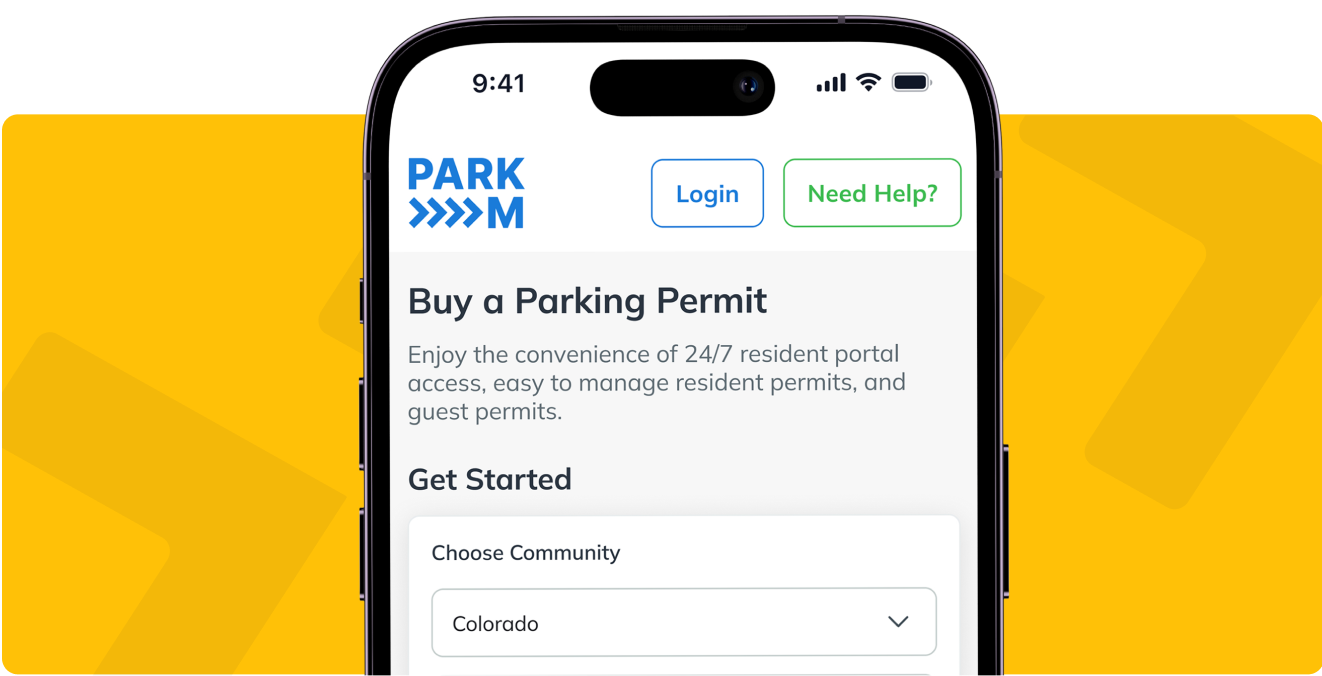
- Our calls: residents and guests contact ParkM’s US-based support team, 7 days a week, instead of your office. With ParkM’s parking permit software, they register, change a vehicle, buy guest permits, and cancel permits themselves online, with no app to download.
- Your record: every enforcement action is timestamped in the property manager portal, next to a live list of permits and plates. Leasing agents can have access without seeing financials, and a regional manager can move between communities with one login.
It doesn’t add a line to your budget, either. ParkM costs the property nothing: there’s no monthly billing to the property, and residents and guests who buy permits fund the program. There’s no contract, and you can leave with 30 days’ notice. How ParkM works walks through a launch from announcement to enforcement.
If a vehicle is wrongly towed, ParkM covers the cost of the tow, plus storage fees up to 24 hours, under the no-bad-tow guarantee. It’s one of four things Why ParkM suggests checking against any vendor.
You’ll still have some parking conversations. Rules and exceptions stay with you on purpose, and a resident who disputes a tow may still come to your office first. The routine calls are what stop.
Stephanie Coats, Property Manager at Lenox Cooper Apartments in Texas, saw it on a holiday weekend: “Even when an issue occurred over a holiday weekend, the team handled it while our staff was away.”
When isn’t outsourcing parking worth it?
Outsourcing parking isn’t worth it if it isn’t costing you anything. If your lot has more spaces than cars, residents aren’t complaining, and you don’t want paid permits, keep it in-house and use your team’s time elsewhere.
ParkM’s own reps say so. One prospect asked whether a garage it already monitored, where residents already paid for their spaces, needed ParkM too. The rep said no, unless the property wanted to add revenue with a permit fee on top.
Permits fund the program, so it fits communities where parking is worth something: a tight lot, guest overflow, reserved spaces, or an owner looking for revenue from parking without raising rent.
Frequently asked questions
Is it cheaper to manage apartment parking in-house?
Rarely, once you count staff time. In-house parking has no vendor fee, but your leasing desk handles permits, guest passes, vehicle lists, and parking calls. ParkM charges the property no fee either, because residents and guests fund it through permits. So the real comparison is your team’s hours.
Do we have to switch tow companies if we outsource parking?
Not with ParkM, though it can happen with a full-service operator that brings its own enforcement. ParkM works with the tow or boot company you already use, under the terms you set. If you don’t have one, ParkM can suggest a partner from its preferred vendor list.
Who handles resident parking complaints if we outsource parking management?
With ParkM, the routine ones go to ParkM’s support team: logins, renewals, vehicle changes, and guest permits. Your office still owns decisions about rules and exceptions. With any vendor, ask who answers a resident at 9 pm on a Sunday, and what that person can fix without calling you.
Can we change our rules or leave if outsourcing doesn’t work out?
Yes. With ParkM, your property can adjust pricing and permit types at any time after the first 60 days, so you can change a rule that isn’t working without waiting for a contract renewal. There’s no contract, and the property can leave with 30 days’ notice.
See what your team would stop handling
If parking calls are taking over your week, book a demo. Bring your list of exceptions from the Pro Tip above, and we’ll show you how each one works at your community.