Your regional manager forwards a link with one line: “Reliant says ParkM has gaps. True?” The link is Reliant Parking’s “Top 10 ParkM Alternatives” page, and it names four: enforcement integration, visitor workflows, resident self-service, and reporting.
Whether you run one community or a portfolio, we’ll cover these three questions: how each of Reliant’s claims measures up when checked against named ParkM features, where Reliant is the better fit, and what Reliant Parking reviews can and can’t tell you. Every detail about Reliant comes from Reliant’s own website, confirmed on October 14, 2026
The short version
| Reliant’s claim | What ParkM has | Where Reliant goes further |
|---|---|---|
| Enforcement integration | Mobile license plate recognition in the enforcement app on your partner’s own phone, tow requests from the portal, a no-tow list, plate blocking, timestamped enforcement history, pin drop for your partner to find the exact vehicle, and a no-bad-tow guarantee | Fixed LPR cameras tied to gates, offline mode |
| Visitor workflows | Guest permits bought by the resident or the guest, limits per unit and community-wide depending on property management preferences, a cap on nights in a row | A manager-approval step and rules by vehicle type |
| Resident self-service | Register, swap or edit vehicles, cancel, and buy guest permits online at any hour, no app download required | A native app with space reservations and a lot map |
| Reporting | A real-time dashboard of permits, vehicles, and enforcement actions, revenue by permit type, and one login across a portfolio | Resident records that update from your property management system |
What has Reliant published about ParkM?
“Top 10 ParkM Alternatives” went up in June 2026, and its case against ParkM is a single paragraph. ParkM, it says, “offers a digital foundation for parking administration, but property managers searching for alternatives suggest that specific operational gaps remain unaddressed.” The four gaps follow.
On October 13, 2026, Reliant added a head-to-head, “Reliant Parking vs ParkM.” It agrees that ParkM costs the property nothing, covers wrongful tows, and runs without a long-term contract, and it ends by reducing the decision to one question: who pays?
The four gaps, checked against ParkM’s features
1. Is ParkM’s enforcement integration shallow?
No. ParkM’s enforcement is built around the partner you already have. Your tow or boot company checks plates with license plate recognition (LPR) in ParkM’s enforcement app, on its own phone, with no equipment to install. ParkM trains your partner as part of the launch. If you don’t have one, ParkM can suggest a company from its preferred vendor list.
From the property manager portal, your team gets:
- Tow requests sent straight from the portal when a vehicle needs to move.
- Visibility of repeat offenders: which vehicles have received multiple violations.
- A no-tow list for staff, vendors, and anyone else you name.
- Plate blocking for a vehicle that shouldn’t be on the property anymore.
- Enforcement history with timestamps, so a disputed tow gets settled from the record instead of from memory.
- Compliance flags for residents who keep collecting warnings.
How ParkM is different: if a vehicle is wrongly towed, ParkM covers the cost of the tow, plus storage fees up to 24 hours. Reliant’s own head-to-head credits ParkM with this and describes its own protection as photo and timestamp records. The terms are on ParkM’s no bad tow guarantee page.
Where Reliant goes further: its enforcement app lists offline mode, photo documentation, and post orders, and Reliant connects fixed LPR cameras to gates at gated or high-volume properties. If you run a gated garage and want the gate to open on a plate match, that’s Reliant’s ground. Both products still need someone in the lot. Reliant lists “Enforcement still requires a person on patrol to use the app” as a limitation of its own platform.
Learn more about how ParkM’s plate checks fit together in LPR parking enforcement.
2. Can you configure ParkM’s guest parking rules?
Yes, and the rules belong to you. A resident can buy a guest permit, or the guest can buy one directly, at any hour, active as soon as payment is confirmed. You set how many guest permits each unit can have, how many the whole property allows, and how many nights in a row a guest can stay. That last limit is the one that stops guest spaces from becoming free overflow for a resident’s second car.
Pro Tip: Set the nights-in-a-row limit before launch, not after the first complaint. A limit residents see on day one reads as policy. The same limit added in month four reads as a rule aimed at someone.
Where Reliant goes further: a manager-approval step before issuing a guest pass, and rules by vehicle type. If your manager wants to sign off on every guest, Reliant has that switch. At most apartment communities, limits per unit and per night do the same job without putting a staff member in the loop. ParkM’s visitor parking permits page covers the guest side in more detail.
3. Can residents really serve themselves in ParkM?
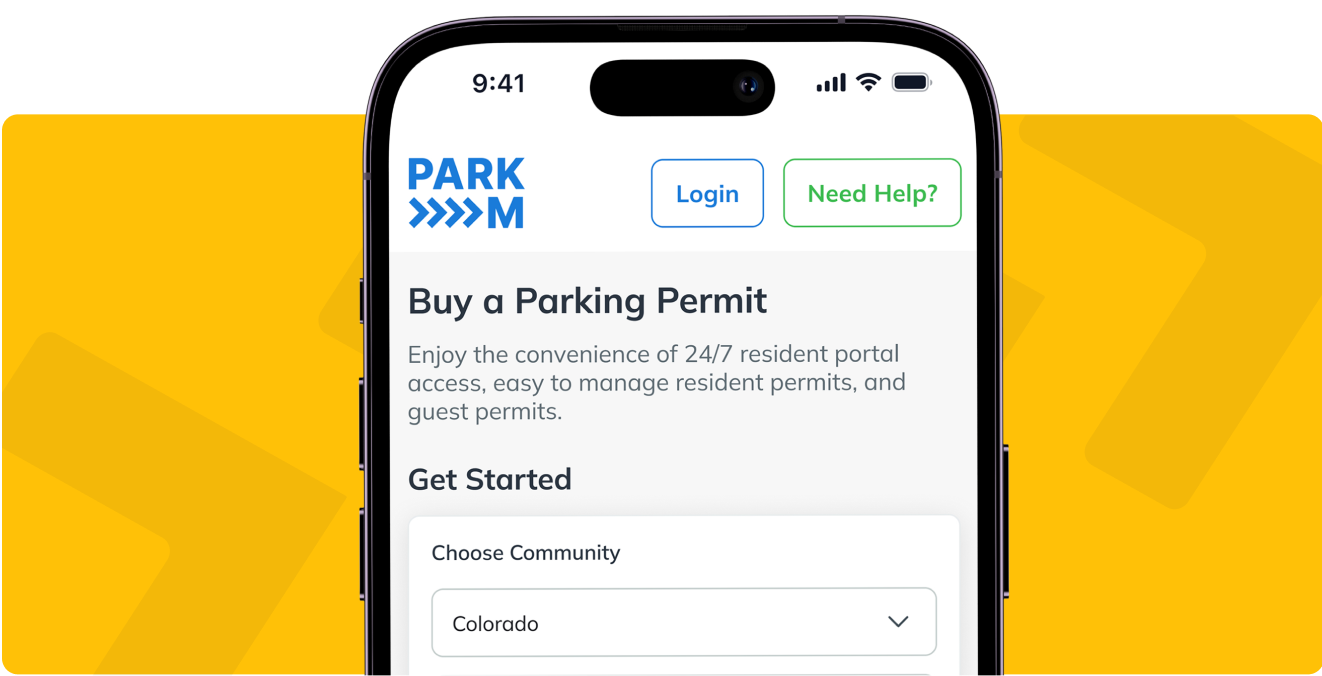
Yes. Residents can register their vehicles, swap a car, cancel a permit with no cancellation fee, and buy guest permits from a phone or computer at any hour. No app download or access code is needed because the license plate is the permit. Residents get an email and a text whenever something on their account changes. When someone does need help, ParkM’s support team takes resident and guest questions directly, seven days a week, so those complaints don’t land at your leasing office.
“We had tried other parking solutions in the past, but they required so much manual work, especially with staff turnover. ParkM has been incredibly easy to use.”
Ana Champion, Regional Manager, Rainey Property Management, CA
Reliant starts with a download. Residents get the app from the App Store or Google Play and enter the one-time access code from their welcome letter. It’s a reasonable setup. It’s also a step that has to reach every unit before anyone can register a car.
Where Reliant goes further: its native app lets residents reserve a space, see open spaces on a lot map, report someone parked in their spot, and chat in the app. Reliant also advertises 24/7 human support for residents, staff, and enforcement. If your community has assigned or reservable spaces, those app features earn their keep. If your problem is whose car belongs in an open lot, you may not need them.
4. Does ParkM’s reporting connect to the rest of your operation?
Partly, and this claim has some weight behind it. Inside ParkM, the property manager portal shows a real-time dashboard of every active permit, vehicle, and enforcement action. It also breaks revenue down by permit type, so the parking income you report to your owner is a number you can check yourself. Regional and portfolio managers get one login across every community, and you can hold financials back from staff who shouldn’t see them. On request, ParkM’s team will audit registered vehicles against your rent roll.
“The dashboard also gives me insight beyond traditional parking enforcement. I can review guest and overnight parking activity and identify patterns that may point to unauthorized occupants or other lease-compliance concerns.”
Tina Pike, Property Manager, Sofi Belmar, CO
Where Reliant goes further: resident records that update from your property management system. The “broader property operations” in Reliant’s wording means lease and move-out data
Does the choice really come down to who pays?
That’s where Reliant’s head-to-head lands: “Does the property pay for the parking program, or does the resident?” In Reliant’s telling, ParkM shifts the cost onto residents, while Reliant keeps it with the property, which pays a custom quote based on community size.
It’s a fair question. The answer leaves three things out.
- Your current residents don’t have to pay at launch. With grandfathering, everyone living at your community when ParkM launches registers for free. Only new move-ins pay, so nobody’s deal changes mid-lease.
- A property-paid model doesn’t always mean residents pay nothing. Reliant’s own Terms of Sale cover parking permits it sells to residents “on behalf of your parking lot owner and/or management company.” Ask Reliant what your residents would pay, as well as what the property would.
- The budget line is the business case. With ParkM there’s no setup cost, no monthly bill, and no invoice to the property. Residents and guests buy permits, and the property receives a share of that revenue. For an owner watching NOI, that’s a new revenue line, not a new expense. Properties that are 100% tax credit and can’t charge a resident to park one vehicle have options with ParkM.
How ParkM works walks through the model and the launch, and why property managers choose ParkM covers the reasoning behind it.
What do Reliant Parking reviews say?
Reliant’s ratings sit in three places, and each measures something different.
| Where | What it shows on October 14, 2026 |
|---|---|
| Capterra | 4.7 from 60 reviews, as quoted on Reliant’s comparison page. Read the reviews there before relying on the score |
| Reliant’s website | A “4.8/5 Average Customer Rating” on its Why Us page, with no source named |
| Apple App Store | “Reliant Parking – Enforcement App,” 3.3 from 14 ratings, left by the people who patrol with it |
Software directory reviews come mostly from property teams, so they speak to onboarding and support. App ratings come from the people holding the phone in the lot. Neither settles the four claims above. A reference call does. Ask each vendor for a community your size, in your state, that’s been live for more than a year, and ask that manager what happens at move-out.
Which one fits your property?
| If your property | Better fit | Why |
|---|---|---|
| Is a gated garage with assigned spaces | Reliant | Gate control from LPR cameras, a lot map, and space reservations |
| Is an HOA that wants the association billed | Reliant | It runs an HOA product. ParkM does not have a similar subscription model. |
| Has open surface parking that’s always been free | ParkM | No cost to the property, and existing residents don’t need to pay to start. The program only impacts new move-ins. |
| Needs parking to stay off the operating budget | ParkM | No setup cost, no monthly bill, and a share of permit revenue for the property |
| Worries most about a wrongful tow | ParkM | It covers the cost of a wrongful tow, plus storage fees up to 24 hours for any incidents logged in our system. |
| Is 100% tax credit | ParkM | ParkM can accommodate with specialized programs |
| Wants residents to skip an app download | ParkM | Residents register online, with nothing to install |
Weighing more than two vendors? ParkM’s comparison of ParkM alternatives sets Reliant beside Parking Boss, Parkade, and others, and the Parking Boss alternative page works through a vendor that publishes its prices.
Moving from Reliant to ParkM
Start with your Reliant agreement, because Reliant lists its contract terms as “available on request” rather than publishing them. On ParkM’s side, the switch needs two things from you: a unit directory and a launch date. ParkM provides support through a designated launch coordinator, resident flyers & letters, and hands-on training for your onsite team and your enforcement partner.
You keep your tow company. ParkM works with the partner you already have. And because there’s no long-term contract, you can leave ParkM on 30 days’ notice if it isn’t working for your community.
Common questions about Reliant Parking
Is there a Reliant Parking app?
Yes. Reliant’s resident app runs on iOS and Android. Residents download it from the App Store or Google Play and set up an account with the one-time access code from their welcome letter. Enforcement teams use a separate Reliant enforcement app.
Does Reliant Parking integrate with Yardi?
Yes. Reliant lists active integrations with Yardi, RealPage, MRI, and Entrata, syncing resident details and move-in and move-out status, typically every four hours. ParkM doesn’t integrate with a property management system today.
How much does Reliant Parking cost?
Reliant doesn’t publish prices. Its own pages describe a custom quote based on community size, paid by the property, with no setup cost. ParkM costs the property nothing, because residents and guests pay for their own permits.
Does ParkM have a mobile app?
Not one you download. Residents and guests use ParkM on any phone or computer at parkm.app, so registering a car doesn’t start with an app install.
Check us both against your own lot needs
Reliant’s pages and this post both come from a vendor’s perspective, so test the claims on your own property. Book a demo, bring Reliant’s quote, and ask ParkM the same three things you’d ask Reliant: what happens at move-out, what your enforcement partner sees on their phone, and what your residents will pay.
Reliant details were checked against reliantparking.com on October 14, 2026. Vendors change their products, so confirm anything your decision depends on with a Reliant representative.