An apartment parking policy is the written set of rules for who may park at your community, where they may park, and what happens when a vehicle breaks those rules. The template below gives you 12 clauses to copy. Fill in the blanks for your property, then check how your state requires the policy to be delivered, because in some states that part is written into law.
Plenty of parking disputes start with a rule nobody wrote down, or with one that was written down and never handed to the resident who broke it.
Key takeaways
- An apartment parking policy should cover registration, vehicle limits per unit, guest limits, prohibited parking, enforcement, disputes, and how the rules change.
- Delivery can matter as much as wording. In Texas, Property Code 92.0131 requires a multifamily landlord to give residents the parking rules before the lease is signed, under a heading reading “Parking” or “Parking Rules” that is capitalized, underlined, or bold.
- A mid-lease rule change in Texas needs written notice and cannot take effect before the 14th day after delivery, except in a construction or utility emergency. Other states set their own rules.
- A resident with a disability may ask for an assigned accessible space as a reasonable accommodation. Federal fair housing guidance uses exactly that request as its first example of what a reasonable accommodation is.
- ParkM does not tow. The property writes the rules and keeps its own tow or boot company, and ParkM keeps the permit record those rules are enforced against.
What an apartment parking policy has to cover
A policy has two readers. The resident needs to know what is allowed. Your enforcement partner needs to know what to act on. A clause that serves only one of them will fail the other at 2am.
That gives every multifamily parking policy the same seven jobs:
- Say who is covered: residents, guests, staff, vendors, and anyone else who parks on the property.
- Define an authorized vehicle, meaning how it gets registered and what makes it legal to park.
- Set the limits on how many vehicles a unit may register and how long a guest may stay.
- Name what is prohibited, from fire lanes and accessible spaces to blocked access and stored vehicles.
- Describe enforcement: warnings, then towing or booting, and who carries it out.
- Give residents a way to dispute, with somewhere to go, a deadline, and a promised response.
- Explain how the rules change, including notice, timing, and who the change applies to.
Several of the parking policy mistakes apartment communities make trace back to one of those seven jobs left undone. Over-permitting is a limits problem. Uneven enforcement is an enforcement problem. Guest parking that turns into resident overflow is a limits problem wearing a guest permit.
The apartment parking policy template
Copy the text in each quoted block. Replace every blank with your community’s own detail. The notes under each clause explain why it is written the way it is, and where you should check local law before relying on it.
The template is written for a digital permit, where the license plate is the permit and nothing is displayed in the vehicle. If your community still issues stickers or hang tags, clause 2 is the one to change.
1. Scope and acknowledgment
PARKING RULES
These Parking Rules apply to every vehicle parked at ____________ (community name), including resident, guest, staff, contractor, and vendor vehicles. They form part of the lease. By signing below, the resident confirms receiving a copy before signing the lease.
The heading is in bold capitals on purpose. Texas requires the paragraph title to read “Parking” or “Parking Rules” and to be capitalized, underlined, or bold. Bold capitals meet that twice over and cost nothing anywhere else.
2. Registration and permits
Every resident vehicle must be registered with the leasing office before it parks on the property. Registration requires the vehicle’s make, model, color, year, license plate number, and state of registration.
A vehicle is authorized to park when its license plate is registered to an active permit. No sticker or hang tag is issued or required. To move a permit to a different vehicle, the resident updates the registration first.
Residents must update their registration within ____ days of replacing a vehicle or changing a license plate.
The information list matches the Texas statute, which allows a landlord to require only those six items before letting a resident park. If you operate outside Texas, check what your own state allows before you ask for more.
3. Vehicle limits
Each unit may register up to ____ vehicles. (Alternative: each leaseholder may register up to ____ vehicles, and no more than ____ per unit.) Additional vehicles require written approval from management and may be limited to ____________ (area of the property).
Set the limit from the spaces you actually have, not from the number of drivers on the lease. A per-leaseholder limit is fairer to a household of roommates, and a per-unit cap stops it growing without limit.
4. Assigned and reserved spaces
A resident with an assigned or reserved space may park only in that space. Assigned spaces may not be exchanged, sublet, or lent without written approval from management. A resident who finds an unauthorized vehicle in their assigned space reports it to ____________ (phone or portal) and does not park in another resident’s space.
The last sentence is there to stop the chain reaction, where one car in the wrong space pushes three residents into three more wrong spaces.
5. Guest parking
Guests park only in spaces marked for visitors. A guest vehicle must have an active guest permit, which the resident or the guest can obtain through ____________ (how guests register). Each unit may hold up to ____ active guest permits at one time. A guest vehicle may park for up to ____ consecutive nights and up to ____ nights in any calendar month.
A vehicle that exceeds these limits is treated as a resident vehicle and must be registered as one under clause 2.
The consecutive-night cap is the clause that does the work. It is what separates a visiting friend from a resident who never registered, and the second sentence tells both of them what happens next. For the tactics that go with it, see how to stop guest parking abuse.
6. Temporary, rental, and loaner vehicles
A resident using a temporary, rental, or loaner vehicle must register it before parking. The temporary registration expires after ____ days unless renewed. A temporary vehicle does not increase the number of vehicles the unit may register.
7. Prohibited parking and uses
No vehicle may park in a fire lane, block a driveway, gate, dumpster, mailbox, sidewalk, or building entrance, or occupy a space marked for another use. The following are not permitted on the property without written approval from management: inoperable, unregistered, or abandoned vehicles; commercial vehicles over ____ feet; trailers, boats, and recreational vehicles; and vehicle repairs other than ____________ (for example, changing a flat tire).
“Unregistered” here means not registered with the community under clause 2. Towing for an expired state registration is a separate question, and some states restrict it. In Texas, Occupations Code 2308.253 bars an apartment community from towing a vehicle merely because it lacks an unexpired license plate or registration insignia. A lease provision allowing that tow is valid only if it requires at least 10 days’ written notice first. Check your own state before you add that rule.
8. Accessible parking and accommodations
Accessible parking spaces are reserved for vehicles displaying a valid disability placard or license plate issued by a state. A resident with a disability may request an assigned space, a space closer to their unit, or another change to these Parking Rules as a reasonable accommodation by contacting ____________ (office or email).
None of the templates that rank for this search includes this clause, and it is the one with federal guidance behind it. The HUD and DOJ Joint Statement on Reasonable Accommodations under the Fair Housing Act (May 17, 2004) answers its own question, what is a reasonable accommodation, with a parking example first. A property assigns no spaces, and a resident with a mobility impairment asks for an assigned accessible space near her unit. The provider must make the exception. Where both the disability and the need are readily apparent, the same guidance says the provider may not ask for more information. The number and layout of the accessible spaces themselves are covered in ADA compliance for parking lots.
9. Staff, vendors, and contractors
Community staff, contractors, and approved vendors park under a staff and vendor list maintained by management. A vehicle on that list is not subject to towing while it is on the property for work.
Without this clause, the first vehicle towed under your new policy is sometimes the plumber’s.
10. Enforcement, towing, and booting
A vehicle parked in violation of these Parking Rules may receive a warning. Repeated or serious violations may result in the vehicle being towed or booted at the vehicle owner’s expense by ____________ (tow or boot company), reachable 24 hours a day at ____________ (phone). A vehicle blocking a fire lane, an accessible space, or emergency access may be removed without a prior warning where state and local law allow it. All towing and booting follows state and local law.
Towing notice and signage requirements vary by state and city, so check your local ordinance before this clause is enforced. Sign size, wording, placement, and how long a sign must be posted before a tow all differ, and so does who may authorize the tow. Towing from private property walks through four states as worked examples.
Warnings first also builds a record. When a resident disputes a later tow, a dated history of warnings protects the leasing team.
11. Disputes
A resident may dispute a warning, a tow, or a boot by contacting ____________ (office or email) within ____ days, with the vehicle’s license plate and a description of what happened. Management will review the parking record for that vehicle and respond in writing within ____ business days.
Avoid “management decisions are final”. It reads as a threat and it invites the argument it is trying to end. A written answer checked against the parking record does more to close a dispute.
12. Changes to these Parking Rules
Management may change these Parking Rules by giving written notice to residents. A change applies to all residents of the community and takes effect no sooner than ____ days after notice is delivered, except in an emergency affecting the parking area, such as construction or utility work. Management keeps a record of how and when each notice was delivered.
Resident name: ____________ Unit: ______
Signature: ____________ Date: ______
Set the notice period from your state’s rule rather than from habit. In Texas a change cannot take effect before the 14th day after the notice is delivered. The record-keeping sentence matters because, in Texas at least, the burden of proving the resident received the notice sits with the landlord.
For a temporary change, such as a holiday weekend when guest demand spikes, the same clause applies. Handling parking during peak times covers what to tell residents ahead of those weekends.
Deliver the policy the way your state requires
A well-written policy handed over the wrong way can still cost you. Texas is the clearest example, because it wrote the delivery rules into Texas Property Code 92.0131. The section applies to a multifamily community, and it sets four requirements:
- If parking or towing rules exist when the lease is signed, the resident gets a copy before signing.
- The rules must be signed by the resident, included in the signed lease, or included in a signed attachment that the lease expressly refers to.
- If the rules sit in the lease or an attachment, the paragraph title must read “Parking” or “Parking Rules” and be capitalized, underlined, or printed in bold.
- As a condition of parking, the landlord may require only the make, model, color, year, license plate number, and state of registration.
The same section sets the penalty. A landlord who breaks the delivery or rule-change requirements is liable for a civil penalty of $100 plus any towing or storage costs the resident incurred. In a suit under the section, the losing side also pays the winner’s reasonable attorney’s fees and court costs. The section also makes a landlord liable for vehicle damage caused by a negligent contracted tow company that has no insurance covering it. Ask your tow partner for proof of that insurance.
Outside Texas, check your own state and city. Whether a parking-specific rule exists, and what it requires, varies by state. A signed lease addendum is common practice, and the signature gives you a record that the resident received the rules. Ask your counsel before you rely on any single form.
How do you change a parking policy mid-lease?
Carefully, and with a paper trail. Texas again sets out the clearest version. A change made during the lease term needs written notice to the resident before they must comply. It cannot take effect before the 14th day after the notice is delivered, unless it results from a construction or utility emergency.
The change must also meet one of two tests. The first is that it applies to every resident in the community and rests on necessity, safety or security, reasonable construction requirements, or respect for other residents’ parking rights. The second is the resident’s written consent.
The landlord carries the burden of proving the notice arrived, and the statute lists the ways to do it. One is certified mail with a return receipt. The other is a note in the landlord’s files recording the time, place, method, and person for a hand delivery, a fax, or a notice taped inside the unit’s main entry door.
That is a lot of process for one rule change. It is also why the cleanest way to change parking rules is often not to change them mid-lease at all.
Grandfathering keeps the change out of the middle of anyone’s lease. Existing residents enroll in the permit program at no charge and keep parking on the terms they already have, and charging starts with new move-ins only. The property picks the window: most keep existing residents free until their lease ends, and a community that runs mostly month to month often uses a 90-day grandfather period instead. That is how ParkM rolls out a permit program, and how ParkM works walks through the launch.
Where a policy stops and your software starts
A policy says who may park. It cannot tell your enforcement partner, standing next to a car at midnight, whether this particular plate is one of them. That is a records problem, and it is the part ParkM handles.
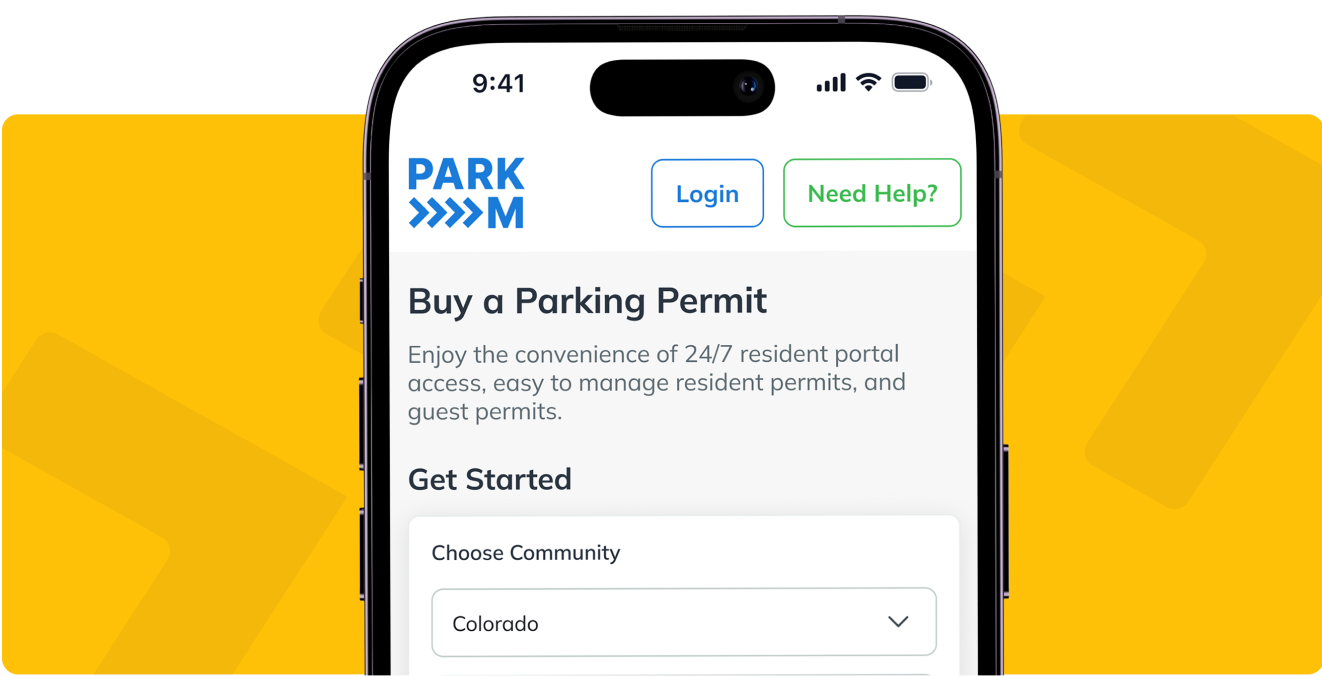
With ParkM, the resident’s license plate is the permit, so there are no stickers or hang tags to issue, lose, or move between cars. Residents and guests register online from a phone, with no app download, and a permit is live the moment it is purchased.
The clauses above map onto settings the property controls:
| Policy clause | How ParkM handles it |
|---|---|
| 2. Registration and permits | Permit types: resident, second vehicle, guest, and reserved |
| 3. Vehicle limits | Permit limits by unit or by leaseholder |
| 5. Guest parking | Daily guest limits and consecutive-day restrictions |
| 9. Staff, vendors, and contractors | A no-tow list for staff, vendors, and anyone else the property names |
| 10. Enforcement | Every enforcement action timestamped, compliance flags for residents with 3 or more warnings, and tow requests for a specific vehicle from the property manager portal |
Guest permits can be bought by the resident or by the guest directly, which is covered on visitor parking permits. Plate blocking handles a vehicle that should no longer be on the property at all.
ParkM does not tow and does not replace your tow company. The property sets the rules and sets enforcement terms directly with its own tow or boot partner. ParkM tells that partner which plates hold an active permit. The program is free to the property, with no monthly billing to the property: the vehicle owner pays for the permit.
Before the policy goes live
Run this list with your leasing team, your counsel, and your tow partner.
- Fill every blank. A rule with an empty limit gives your enforcement partner nothing to act on.
- Count the spaces, then check that the per-unit and guest limits fit inside them.
- Put the policy in the lease itself or in a signed addendum the lease refers to, headed “Parking Rules” in bold capitals.
- Check your state’s delivery and notice rules. Texas has them in Property Code 92.0131, your state may have its own, and your city may add to them.
- Match the policy to the signs. Tow-away signage has its own state and city requirements, separate from the policy.
- Confirm your tow or boot partner’s process: who authorizes a tow, what they file, and proof of insurance.
- Build the staff and vendor list before the first night of enforcement.
- Name the dispute contact, and make sure that person knows the deadline in clause 11.
- Tell residents before you enforce. A notice period and a warning phase give everyone time to register.
- Reconcile registrations against the rent roll and the unit directory, because the list drifts from who actually lives there.
Frequently asked questions about apartment parking policies
Does an apartment parking policy need to be part of the lease?
In Texas it has to be signed, and it has to be handed over first. Rules that exist when the lease is signed must reach the resident before signing. They must then be signed by the resident, included in the lease, or included in a signed attachment the lease expressly refers to. Elsewhere it depends on your state, and a signed lease addendum is common practice.
Can an apartment community change its parking rules in the middle of a lease?
In Texas, yes, with notice and within limits. A mid-lease change there needs written notice and cannot take effect before the 14th day after delivery, except in a construction or utility emergency. It must also apply to every resident and rest on a reason the statute names, or have the resident’s written consent. Other states set their own rules, so check yours.
What vehicle information can a landlord require from residents?
In Texas, as a condition of parking, a landlord may require only the make, model, color, year, license plate number, and state of registration. Outside Texas, check your own state’s law. Either way, ask for what your enforcement partner needs to identify the vehicle and nothing beyond it.
How many guest permits should an apartment community allow?
There is no standard number, so start from your visitor spaces rather than from a rule of thumb. The limit that matters most is consecutive nights. A cap on active permits per unit keeps the lot fair on a busy evening. A consecutive-night cap stops a guest permit from quietly becoming a resident vehicle nobody registered.
Does ParkM tow vehicles?
No. ParkM is the permit and visibility layer. Your community keeps its own tow or boot company and sets enforcement terms with that company directly. ParkM tells that partner which plates hold an active permit, records every enforcement action with a timestamp, and covers the cost of a wrongful tow, plus storage fees up to 24 hours.
Put the policy to work
A parking policy is only as strong as the record behind it. The template gives you the rules. The delivery rules decide whether they hold. The permit record decides whether the person at the vehicle can see them.
If you want to see how these clauses look as settings rather than paragraphs, book a demo and bring your current policy with you. If you would rather start with what changes day to day for your on-site team, apartment parking management for property managers covers that.
This template is a starting point, not legal advice. Parking, towing, and landlord rules vary by state and by city, and they change. Have your counsel review the policy before you adopt it.
Texas Property Code 92.0131 and the HUD and DOJ Joint Statement read September 2026. Last reviewed September 2026.