To track the vehicles parking on your property, you need two things: a list of the license plates allowed to park there that’s accurate in real time, and someone who checks the lot against that list on a schedule. A spreadsheet, stickers, a gate, cameras or a digital permit can each hold the list. They differ in how current it stays and who has to do the checking.
Here’s how the problem usually shows up. A gray pickup has sat in the same visitor space for nine days. A resident emails about it on Monday and calls on Wednesday.
Nobody in the leasing office can say whose it is, whether it’s allowed, or who’s supposed to find out.
Whether you run one community or a dozen, that’s the gap tracking should close. In this guide, you’ll see what tracking vehicles on an apartment lot involves, how five common tools compare, why you can’t just look up a plate, and how to keep your list of plates from going stale.
Quick Answer
To track vehicles parking on your property, keep a list of the license plates allowed to park there, tied to the resident or guest each one belongs to, and have someone check the lot against it regularly. A digital permit tied to the plate keeps that list current without stickers, gates or cameras.
What does tracking vehicles on an apartment lot mean?
For a property manager, tracking vehicles means you can answer four questions about any car in your lot, at any hour. Most tools answer one or two of them.
- Is this plate allowed to park here? Resident, guest, staff, vendor, or none of those.
- Who does it belong to? A name turns a mystery car into a phone call.
- Is the answer current tonight? Residents switch cars, roommates move in, and guests come and go. A list that was right last month won’t help at 11pm when your enforcement partner is checking.
- Who checks the lot against the list? A list nobody checks doesn’t change who parks where.
It doesn’t mean watching every car come and go around the clock. You don’t need a log of every arrival to know whether the truck in space 14 has a permit. You need the list, and someone who looks.
When you can’t answer those four, the cost lands on your team: complaints with nowhere to go, tows you can’t back up, and residents who stop believing the rules apply to everyone. ParkM’s property manager portal puts the first three on one screen and keeps a timestamped record of every enforcement action.
What can I use to track vehicles parking on my property?
There are five common options. Each one keeps the list of allowed vehicles in a different place, and each has a different weak spot.
A spreadsheet or paper log
This is where most communities start. Your team records each resident’s plate, make, model and unit at move-in, and someone keeps it up to date.
It tells you whose car is whose, as long as somebody updated it. That’s the catch.
A resident who trades in a car on Saturday stays on the spreadsheet with the old plate until they tell the office, and most don’t. A file on the office computer also doesn’t help whoever is in the lot at night.
Parking stickers and hang tags
A sticker or hang tag tells you a car had permission at some point. It doesn’t tell you whose car it is without a separate lookup, and it doesn’t tell you the permission is still good. Tags move between cars, stickers stay on cars that have left, and a resident who never picked one up looks exactly like a stranger.
One portfolio manager described the risk on a call with ParkM: it’s “a big lift if somebody gets towed incorrectly because the team forgot to give them a parking tag.” For the price side, see what parking permit stickers and hang tags cost your property.
A gate with fobs or cards
A gate controls who gets in, and you can shut off a fob when someone moves out. It tells you a credential was used, not which car came through on it. It also can’t help with a car parked in the wrong space once it’s inside.
Guests need a way in too, which usually means a call box or a loaner fob. And a gate is hardware, with an install cost and repairs that land on the property’s budget.
Security cameras that capture plates
Cameras are good at one thing: showing what happened. A camera can show when a car arrived and whether it clipped a pole. On its own, it can’t tell you whether that car was allowed to park there, because it has no list to compare against unless you buy a plate-reading system that keeps one.
Cameras that read plates also come with rules. According to the National Conference of State Legislatures, at least 28 states have laws on how automated license plate readers are used or how long their data is kept.
Most of those laws are written for police, but not all of them. Check your state’s rules with your attorney before you put up a camera that reads plates.
A digital permit tied to the license plate
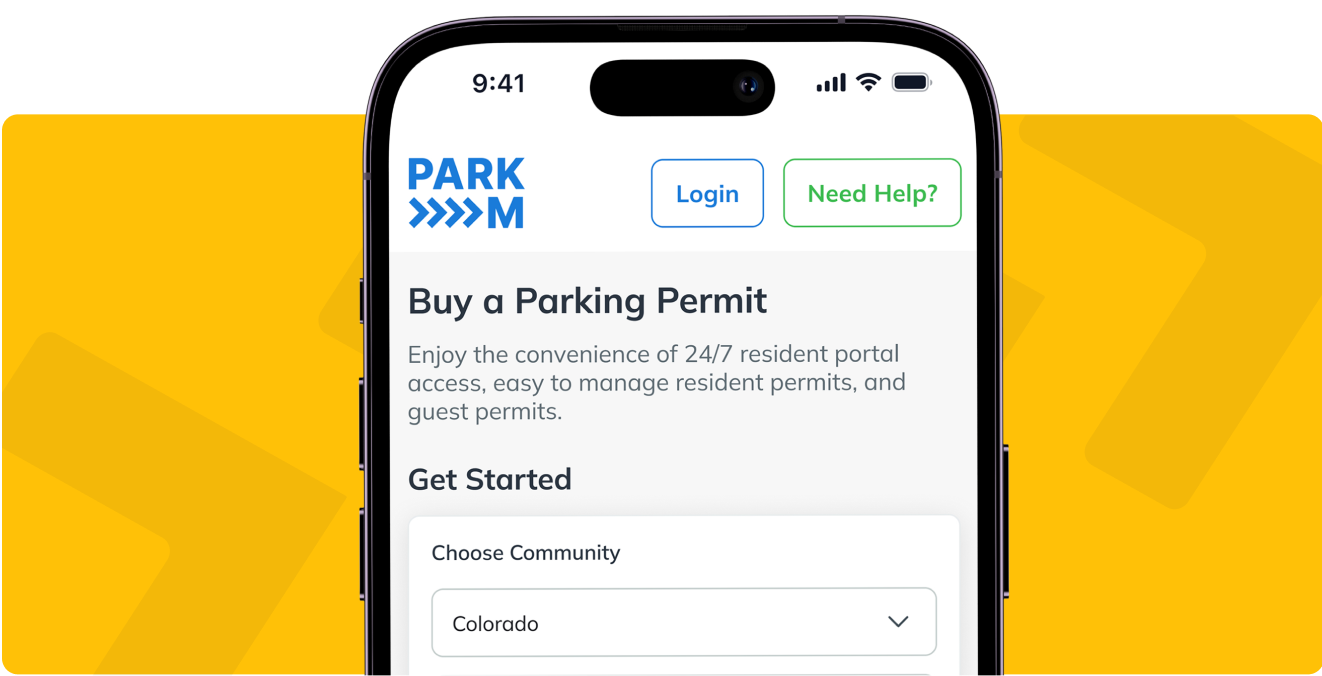
With a plate-based permit, the resident registers their own vehicle and the plate becomes the permit. The list of allowed plates is the permit record itself, so it changes the moment a resident buys, swaps or cancels a permit.
Your enforcement partner checks plates against that list from a phone, and nothing is installed at your property. Here’s how plate reading from a phone works with ParkM.
Its weak spot is that it only knows what’s registered. A car that was never registered comes back as not allowed, which is the point. But your rollout has to get every resident registered first.
How the five compare
| Shows a car is allowed | Shows whose car it is | Current tonight | Who checks the lot | Installed at the property | |
|---|---|---|---|---|---|
| Spreadsheet or paper log | Yes, if someone updated it | Yes, if someone updated it | Only as of the last update | Your team, or a printout handed to your tow company | Nothing |
| Stickers and hang tags | At some point in the past | Only with a separate lookup | No | Your tow company, car by car, reading windshields | Nothing, but you keep reordering tags |
| Gate with fobs or cards | Shows a credential got in | Shows who holds the fob, not which car | For fobs, yes. Not for cars already inside | Nobody, unless someone also patrols | Gate, arms, readers and fobs |
| Security cameras | Only with a plate-reading system that holds a list | Only with that list | Depends on the list | Someone reviewing footage, after the fact | Cameras, power, network, and your state’s rules to follow |
| Digital permit tied to the plate | Yes | Yes, the resident or guest who registered it | Yes, a permit counts from the moment it’s bought | Your enforcement partner, from a phone | Nothing |
Picture Dana, a community manager at a 168-unit community who keeps a careful spreadsheet. She updates it at every move-in and gives the tow company a fresh printout each month.
In March, a resident sells her sedan and drives home in a new SUV. She doesn’t tell the office, because nothing prompts her to. Two weeks later, the SUV is towed from her own assigned space.
The spreadsheet was accurate on the day it was printed. Dana’s diligence wasn’t the problem. The list only changed when someone in the office changed it.
Can you look up who owns a car from its license plate?
Usually not. State DMV records are covered by the federal Driver’s Privacy Protection Act, which lets a DMV release an owner’s personal information only for the uses the law lists.
“It’s parked on my property” isn’t one of them. Sending notice to the owner of a towed or impounded vehicle is. You can read the full list of permitted uses under 18 U.S.C. 2721.
So the only owner record you can count on is the one your community builds when a vehicle is registered. If a car isn’t on your list, the plate alone usually won’t tell you whose it is. Your state may add its own rules, and your attorney is the authority on what applies to you.
Pro Tip: When an unknown car keeps turning up, photograph the plate and note the date, time and space each time you see it. If it ends in a tow, that log and your posted signs are what back up the decision.
How do you keep the list of plates accurate?
Every tracking method fails the same way: the list goes stale. These five habits keep it current, whichever tool you use.
- Record the plate at move-in. Not only a sticker number or a space number. The plate is the one thing on the car anyone can check in the lot.
- Make updates the resident’s job. Residents change cars more often than they tell the office. With ParkM, residents swap vehicles and update their plate themselves, at any time, at no charge.
- Register guests by plate, with limits. Set how many guest permits a unit can have and how many nights in a row a guest can stay, so guest parking doesn’t turn into resident overflow. ParkM’s guide to stopping guest parking abuse goes further.
- Take plates off the list at move-out. A plate that outlives its lease is a gap in your list. ParkM also lets you block a plate, which is how communities handle an evicted resident’s car.
- Keep a no-tow list for staff and vendors. Your maintenance team, your landscapers and your pool contractor park onsite too. Put their plates on a no-tow list so your enforcement partner doesn’t flag them.
Here’s what step 5 saves. Say a regional manager signs a new landscaping contractor for three communities and forgets to tell anyone onsite. On the crew’s first Tuesday, their truck gets a warning on the windshield at the first stop.
The contractor calls the regional, the regional calls the community manager, and a morning goes to a truck that was supposed to be there. Putting the crew’s plates on the no-tow list before their first visit would have prevented all of it.
Who checks the lot, and how often?
The list is half of tracking. The other half is someone comparing the lot against it, regularly, including after the office closes.
Doing that on foot is a real job. One property manager, costing out a proper walk of her lot on a call with ParkM, said “it would easily be 12 hours,” then settled on “10 to 12 hours a week.” Most onsite teams don’t have those hours, so the check quietly stops happening.
With ParkM, the check belongs to your tow or boot company, under terms you set with it. Your enforcement partner reads plates with license plate recognition (LPR) on a phone while they patrol, and each car comes back as permitted or not against your current list. When and how often they patrol is part of your agreement with them, not ParkM’s call.
If you don’t have a tow partner yet, ParkM can refer you to one from its preferred vendor list. For the full split of who does what between the property, ParkM and your enforcement partner, see ParkM’s page on parking enforcement services.
Pro Tip: Ask your tow company to put its patrol times in writing, including at least one late-night pass. That’s when nobody from the office is around to see the lot.
What does ParkM track, and what doesn’t it?
ParkM tracks the permit list: every active permit, the plate it belongs to, and the resident or guest who holds it. Your enforcement partner looks plates up against that list. That’s all it tracks.
What ParkM keeps for you:
- The list of permitted vehicles and their owners, in the property manager portal. A permit counts from the moment it’s bought, so a resident who registers at 11pm is on the list at 11pm.
- Updates from residents themselves. Residents register, swap vehicles and cancel permits online, with no app to download. Guests, or the residents they’re visiting, buy guest permits the same way.
- The rules you set, applied the same way to every car: permit types, limits per unit, guest limits and consecutive nights.
- A timestamped record of every enforcement action, so you can see what happened and when.
What ParkM doesn’t do:
- It doesn’t install anything. No cameras, gates or readers go up at your property.
- It doesn’t watch your lot around the clock or log every car that comes and goes. Your enforcement partner checks the list when they patrol.
- It doesn’t tow. Your community keeps its own tow or boot company and sets the terms with it directly.
If a permitted car is towed by mistake, ParkM covers the cost of the tow, plus storage fees up to 24 hours. The no bad tow guarantee explains how a claim works.
ParkM also doesn’t add a line to your budget. It’s free to the property, with no monthly billing, because residents and guests pay for their own permits.
Eusebio, Community Manager at Park Place at Expo in Colorado, described what tracking by hand looked like before: “At one point, we even discovered one resident had 15 vehicles registered at the property. We were also spending hours every day manually tagging vehicles, which took up nearly half of my workday and still wasn’t solving the problem.”
Want to see the list your team and your enforcement partner would work from? Book a demo and ask for a walk through both views.
Questions property managers ask about tracking vehicles
Is it legal to record license plates in my parking lot?
It depends on how you do it. Cameras and automated license plate readers are regulated in many states: at least 28 have laws on how they’re used or how long their data is kept.
A list of plates your residents registered themselves is a different kind of record. Ask your attorney what applies in your state.
Can I track vehicles without a gate or cameras?
Yes. A plate list that residents and guests keep current, checked by your enforcement partner from a phone, tells you whether a car is allowed and whose it is, with no hardware at the property.
What should I do about a car that isn’t on the list?
Follow your posted rules and your state’s towing law. Many communities warn first, and your tow or boot company acts under the terms you’ve set with it.
ParkM’s guide to towing from private property sets out the sign and authorization rules state by state. If you think a vehicle is abandoned or stolen, call the police non-emergency line first.
Do residents need to download an app?
No. Residents and guests register and buy permits online, from a phone or a computer.
Where this leaves you
Tracking vehicles on your property comes down to a list and a check. The list has to name every allowed plate and stay current without your team chasing it. The check has to happen, at night too, by someone who can act on it.
Start with whichever of the four questions your community can’t answer today.
If nobody can say whose a car is, collect plates at registration. If your list always runs a month behind, make updates the resident’s job. If nobody checks after 6pm, that’s a conversation with your tow company.
When you’re ready to see how ParkM would run it at your community, book a demo. Or see how the program works day to day on parking management solutions for property managers.