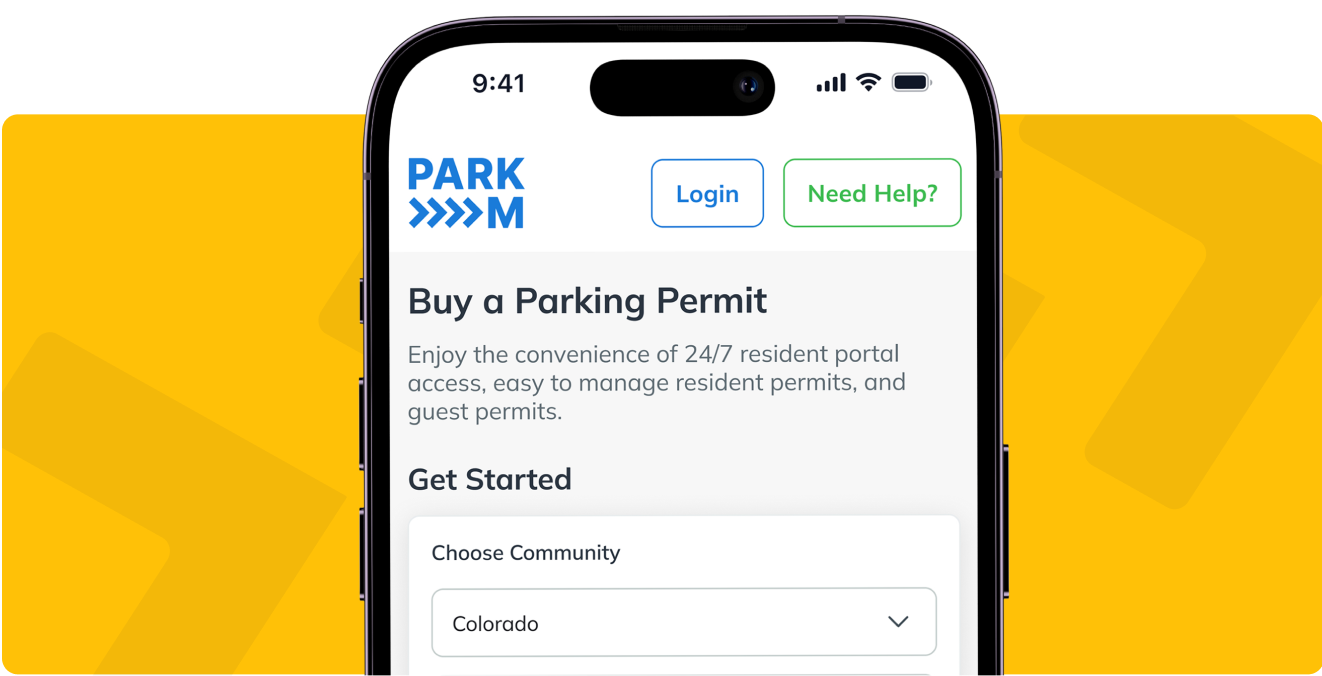
“Parking permit only” means only vehicles with a valid permit for that lot, zone, or space may park there. Without one, you can expect a ticket on a city street, or a tow or boot on private property such as an apartment community, depending on what the sign and local laws say. In permit-only areas, guests usually need a permit too.
That is the whole answer for a driver. For a property manager, the sign is where the work starts.
A permit-only sign makes a promise to every resident who pays for a space: the car in your spot will be accounted for. Whether that promise holds depends on three things the sign cannot do on its own. It has to meet your state’s rules, somebody has to check the cars, and the list they check against has to be accurate when they are checking, not right on the day it was printed.
When that list is out of date, it costs you in two places: staff time spent on disputes and residents who stop trusting enforcement. That’s true at a single community, and it adds up fast across a portfolio.
Today, we’re covering what your sign has to say in your state, how enforcement should run once it’s posted, and how to keep the permit list current.
Key takeaways
- “Parking permit only” means a vehicle needs a valid permit for that lot On a public street, the city issues permits and tickets. In an apartment lot, the property sets the rules and it chooses the enforcement type and company, typically towing or booting.
- The rules for signs and towing on private property vary by state, and often by city. A permit-only sign isn’t automatically a legal tow-away notice, so check your state’s statute and local ordinance before the first tow.
- Many wrongful tows at apartment communities start with an out-of-date permit list: a forgotten sticker left on at move-out, a guest pass that never reached the lot, a new car left unregistered.
- A license-plate permit keeps the list live. The plate is the permit; a resident or guest purchase from their smartphone, and your enforcement partner checks plates against the current list before acting.
- With ParkM, the property keeps its rules and its own tow company, pays nothing, and gets 10 free parking signs carrying a QR code for its community.
What does “permit parking only” mean on a city street versus an apartment lot?
“Permit parking only” means the same thing in both places: a permit is required, but who issues it and who enforces it are completely different. On a public street, the city runs the program. On a private lot, the property does.
| City street permit zone | Apartment community lot | |
|---|---|---|
| Who issues the permit | The city or its parking agency | The property, often through a permit provider |
| Who sets the rules | City ordinance: zones, hours, time limits | The property’s parking policy and lease |
| Who enforces | City parking officers | The property’s own tow or boot company |
| What a violation costs the driver | A citation, sometimes a tow | Usually a warning first, then a tow or boot at the owner’s expense |
| Which law governs a tow | Municipal code | State towing law, plus any local ordinance |
City permits often work as an exemption rather than a reservation. In San Francisco, for example, a residential parking permit exempts you from the posted time limit in your area, so a driver without one can often still park there for a limited time. Read the whole sign, including the days, the hours, and any zone letter printed on it.
On an apartment lot, “permit only” usually means exactly what it says. A vehicle without a valid permit isn’t supposed to be there at any hour the sign covers.
What happens if you park in a permit-only spot without a permit?
On a city street, you’ll most likely get a ticket. On private property, you risk a tow or a boot at your expense once the property’s posted rules and your state’s requirements have been met.
If you’re visiting someone at an apartment community, ask your host how guest parking works before you park. Many communities sell guest permits by the night, and some let the guest buy one directly from their phone. If you’re a resident with a new car, register the new plate before you park it, because the old permit usually won’t cover it.
What a permit-only sign has to say at your community
What your sign must say depends on your state, and often on your city. No single rule covers every property, so treat anything you read here as a starting point and check your own state statute and local ordinance before any vehicle is towed.
Two different signs tend to get confused:
- The permit sign tells drivers a permit is required and, ideally, how to get one.
- The tow-away notice is the sign your state may require before a vehicle can legally be removed. States set its wording, size, placement and how long it has to be up.
Florida is a good example of how specific the second one can be. Florida Statutes 715.07 requires the notice to say that unauthorized vehicles will be towed at the owner’s expense, to show “tow-away zone” in letters at least 4 inches high, to name the towing company and its current phone number, and to be up continuously for at least 24 hours before any tow. Other states write different rules entirely.
Pro Tip: Before you order signs, look up your state’s tow-away notice rules. Our guide to towing from private propertycompares four states side by side, including who at your community is allowed to authorize a tow.
The permit sign has a simpler job, and it matters more day-to-day than most managers expect. A sign that only says “permit parking only” tells a guest what they can’t do. A sign with a QR code on it tells them what to do instead, standing in the lot at 11pmwhen the leasing office closed.
Want residents and guests to get a permit without a trip to the office? See how ParkM works for property managers.
How permit-only enforcement actually works
Enforcement on a permit-only lot is split across three roles. You set the rules. A record says which vehicles are permitted. Your tow or boot company checks cars against that record and acts on your terms.
A flow that works at most communities looks like this:
- Announce it: residents hear the rules, the start date, and how to get a permit before any enforcement begins.
- Warn first: vehicles without a permit get a warning notice, not a tow, for an initial period.
- Tow deliberately: when towing starts, one or two tows are often enough. Word gets around a community quickly.
- Keep the record: every warning and tow is logged with a time, so a dispute is settled by the record.
One boundary trips managers up. A public road running through your community can’t be towed from by the property, whatever sign is posted on it.
Pro Tip: Build your no-tow list before the first warning goes out. Put the vehicles that must never be towed on it, such as staff and vendors, so your enforcement partner never has to guess.
Picture a 240-unit community on a Friday night. A resident, comes home and finds a pickup in her reserved space.
Under a paper system, she calls the tow company. The driver asks for proof the truck isn’t permitted, and nobody at the office can answer until Monday. The truck stays. That resident’s next call is to the regional manager.
The sign did its job. The permit list didn’t.
Why a permit-only lot fails without a live permit list
A permit-only lot fails when the list of who’s allowed to park is out of date, because your enforcement partner can only be as accurate as the list they check. A wrongful tow is usually an administrative mistake.
The list goes stale in predictable ways:
- Move-outs keep their stickers. A hang tag or window sticker keeps “working” long after the lease ends, because nothing on the tag knows the lease ended.
- New cars go unregistered. A resident buys a car and keeps parking in their space, and the tow driver sees a vehicle with no permit.
- Guest passes never reach the lot. A resident gets a paper guest pass from the office, the guest leaves it on the passenger seat, and the car gets towed anyway.
- The office is closed when it matters. Guests arrive in the evening and on weekends, which is exactly when nobody is at the desk to issue a pass.
Each of these produces the same outcome: a resident or guest who believed they were permitted, a record that says they weren’t, and a dispute that lands on your leasing team. Your team doesn’t get that time back, and one more resident doubts the rules are applied fairly.
We covered the sticker problem in detail in our comparison of parking permit stickers and digital permits, and the guest side in how to stop guest parking abuse.
Take a resident who moves out in March. His sticker stays on his windshield.
In May, he starts parking in his old space overnight while visiting a friend who still lives there. To the tow driver, he’s a permitted resident. To the resident who now leases that unit and pays for that space, he’s the reason the sign means nothing.
Pro Tip: Whatever permit system you use, compare your permit list against your rent roll on a set schedule, such as the first of every month. A permit that’s outlived its lease is the next car in somebody’s paid space.
Where a license-plate permit fits
A license-plate permit fixes the list, because the permit is attached to the plate rather than printed on a sticker. When a resident moves out, changes cars or cancels, the record changes with them, and your enforcement partner checks the plate against the list as it stands that night.
At least one large city has moved the same way. San Francisco’s transit agency has moved its residential permit enforcement to license plate recognition and no longer issues sticker permits for standard residential permits.
This is how ParkM runs a permit-only lot:
- The resident’s license plate is the permit. There are no stickers, hang tags or paper passes to hand out, and residents don’t have to download an app.
- Residents and guests get permits themselves, at any hour. A guest permit can be bought by the resident or by the guest directly, and a permit is live the moment it’s purchased. You can cap guest permits per unit and per night, and our visitor parking permits page covers the guest side in more detail.
- Your enforcement partner verifies plates from a smartphone. License plate recognition is built into the enforcement app, so there’s no equipment to install. Before a tow, the operator can also check the last six digits of the vehicle’s VIN, which residents enter when they register, to confirm the car matches the record.
- Every enforcement action is timestamped and documented, which protects your leasing team in a dispute, and you can keep a no-tow list for staff and vendors.
- You keep your own rules and your own tow company. The property sets enforcement terms directly with its tow or boot partner. ParkM is not the tow company. Our parking enforcement services page sets out who does what.
- Signs are included. ParkM provides 10 free parking signs carrying a QR code for your community, so a guest can buy a permit standing in the lot. Your state’s tow-away notice is still a separate item.
“We regularly review our parking records, and the information ParkM provides aligns with what we see internally, which gives us confidence that the program is working as intended.”
Stephanie Coats, Property Manager, Lenox Cooper Apartments, TX
ParkM costs the property nothing. There’s no monthly billing to the property, and because a wrongful tow is the thing every manager dreads, ParkM is confident enough in the accuracy of its verification technology to cover the cost of a wrongful tow, plus storage fees up to 24 hours. The terms are on our no bad tow guarantee page.
If you’re worried about changing the rules on current residents, ParkM can grandfather them: existing residents enroll for free, and only new move-ins pay. More detail on the resident side is in our guide to virtual parking permits.
Questions property managers ask about permit-only parking
Is a “permit parking only” sign enough to tow a car?
Not necessarily. Many states require a separate tow-away notice with specific wording, size and placement, and some require it to be posted for a set time before any tow. Check your state statute and your city’s ordinance before the first tow.
Can we require guests to have a permit?
Yes, on your own lot you can require guest permits as part of your parking policy. The practical question is whether a guest can get one when they arrive, which is why self-service guest permits and a QR code on the sign matter more than the rule itself.
Can we tow a vehicle parked on a public road inside our community?
No. A public road isn’t yours to enforce, even if it runs through your community. Your permit-only rules apply to the lots and spaces you control.
What should a permit-only lot have in place before enforcement starts?
A written policy residents have seen, signs that meet your state’s rules, a current list of permitted vehicles, a no-tow list for staff and vendor vehicles, and a warning period before the first tow. The permit list is the item most likely to be wrong.
A permit-only sign is a promise, and the list is what keeps it
“Parking permit only” tells a driver one simple thing. For the property behind the sign, it’s a commitment to every resident who pays for a space, and it only holds if the right cars are on the list tonight.
Get the state requirements right and warn before you tow. Then keep the permit record live, because that’s the part that slips first.
If your community still runs on stickers, hang tags or a spreadsheet at the front desk, book a demo and see how a license-plate permit program would run at your property, at no cost to the property.