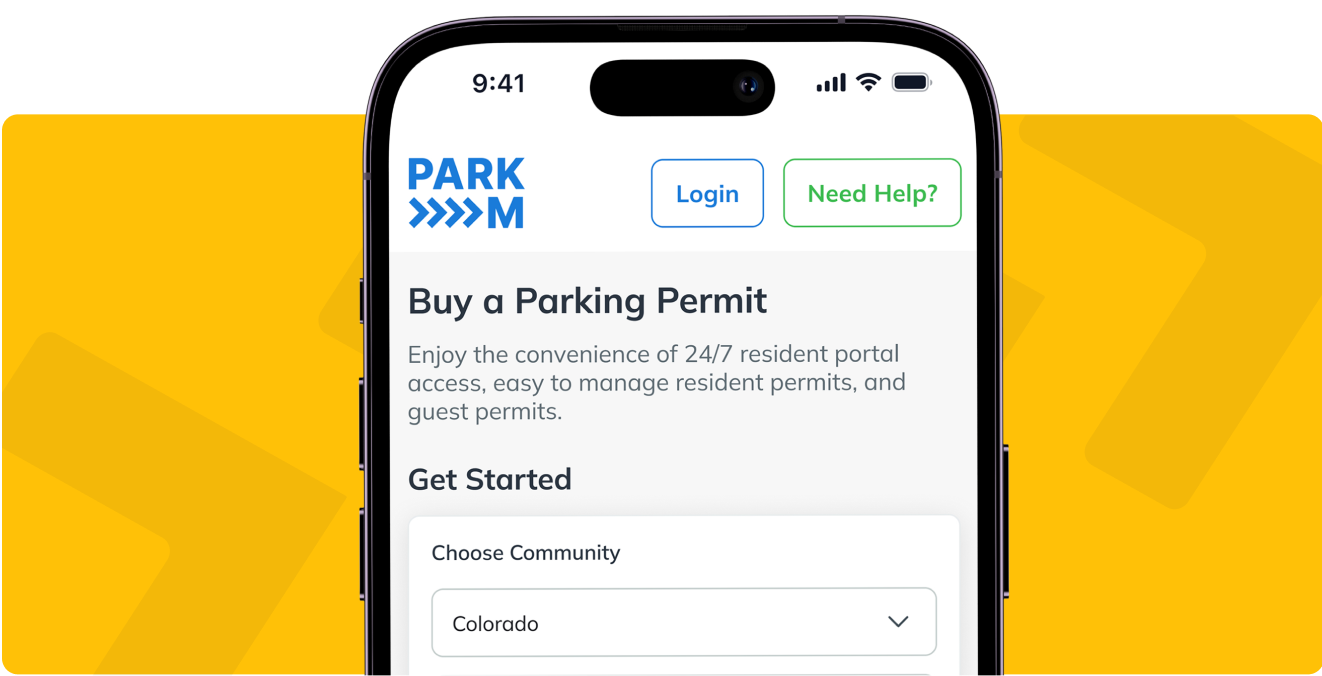
As a property manager, you have two demos from two different vendors with very similar pitches. The license plate is the permit, residents register themselves, and nobody installs anything. Now your regional manager wants one name and a reason.
Here’s the short answer. ParkM and Apartment Permits build the same core product, so the choice comes down to the work around the software: who answers your residents’ parking questions, who pays when a car is towed by mistake, and how current residents move onto paid parking. Apartment Permits suits enforcement companies and lots that rely on boots. ParkM suits properties that want parking problems out of the leasing office.
Whether you run one community or a whole portfolio, you’ll see where the two match, where they split, and when Apartment Permits is the better fit. Every Apartment Permits detail below comes from its own website, read on November 9, 2026.
Key Takeaways
- Both make the license plate the permit, no app to download, let residents and guests register vehicles themselves, and flag near-match plates before anyone acts on them.
- Apartment Permits’ contact page says it doesn’t provide support to residents or guests and sends them to the property or the enforcement company. ParkM takes resident and guest support directly.
- ParkM is confident enough in the accuracy of its verification technology to cover the cost of a wrongful tow, plus storage fees up to 24 hours. Apartment Permits’ pages don’t describe a comparable guarantee.
- Apartment Permits sells to enforcement companies as well as properties, with violation approval, enforcement invoicing, and a self-release boot.
- ParkM costs the property nothing. Ask Apartment Permits directly how its program is paid for at your community.
ParkM and Apartment Permits at a glance
| ParkM | Apartment Permits | |
|---|---|---|
| The permit | The license plate. No stickers or hang tags | The license plate. Nothing to issue or print |
| App download | None for residents or guests | None. Works on any phone |
| Resident and guest support | ParkM’s team handles it directly | Residents and guests are sent to the property or the enforcement company |
| Mistyped plates | Near-match flags for the officer to review | SafePlate flags close matches |
| A wrongful tow | ParkM covers the cost of the tow, plus storage fees up to 24 hours | No guarantee described on its pages |
| Current residents and paid parking | Grandfathering: current residents enroll free, new move-ins pay | A set number of free permits per unit, with charges for extras |
| Enforcement | Your own tow or boot company, with plate recognition in an app on your partner’s phone | Any vendor you choose, with violation tracking and enforcement invoicing |
| Launch | A dedicated launch coordinator, pre-written resident communications, and staff training | A published 4-week rollout plan your team works through |
| Who buys it | Property and portfolio managers | Property managers and parking enforcement companies |
What do ParkM and Apartment Permits have in common?
On the core permit system, they’re close to a tie. Both replace stickers and hang tags with a plate-based permit, and both keep the leasing office out of routine vehicle changes. Here’s what you get with either one:
- Residents add, change, and remove vehicles online, without an office visit.
- Guests register themselves, or a resident registers them.
- You set guest limits, so visitor parking doesn’t turn into overflow for residents.
- You can sell reserved spaces and permits for extra vehicles.
- One login covers a portfolio of communities.
- Every registration and change is logged with a timestamp, so disputed permits are matters of record.
- You choose your enforcement partner and can keep the one you have.
If your shortlist stops at the feature list, you won’t find a winner. The differences show up in who does the work once the system is live.
Who answers your residents’ parking questions?
This is the biggest day-to-day difference between the two. Apartment Permits’ contact page says it doesn’t provide support to residents or guests and can’t help with their accounts. It sends them to their property or their parking enforcement company.
ParkM handles resident and guest support directly. When a resident can’t register a new car, or a guest’s permit won’t go through, they call ParkM, not your front desk.
That matters most when your office is closed. A guest arriving on a Saturday evening doesn’t wait for Monday. Under one model, the call lands on your team or your tow company. Under the other, it goes to the vendor that runs the system.
Ana Champion, Regional Manager at Rainey Property Management in California, put it this way:
“The ParkM platform is simple, and whenever residents need assistance, the customer service team is responsive, thorough, and helpful.”
If your property already staffs its own resident help line, Apartment Permits’ approach may suit you. If your onsite team is stretched, every parking call that bypasses the office is time back for leasing and renewals.
Pro Tip: In each demo, ask the vendor to walk through one call: “A resident’s guest can’t register on a Sunday evening. Who picks up, and what do they see?” The answer tells you who your residents will be calling.
What happens if a car is towed by mistake?
Both systems try to stop a bad tow before it happens. Only ParkM says who pays if one happens anyway.
Picture a resident at a 240-unit community who registers her new car as ABC123 when the plate reads ABC1234. One missing character is all it takes for a permitted car to look unregistered.
Both vendors have planned for it. Apartment Permits’ enforcement features include SafePlate, which detects close matches so a vehicle isn’t towed or booted over a typo. ParkM’s near-match feature flags lookalike characters, such as an I read as a 1, for the enforcement officer to review. Your partner can also verify the last 6 digits of the VIN against the vehicle.
The difference is what happens after a wrongful tow. Apartment Permits’ terms of service make users responsible for the accuracy of the plates they enter. They also say it doesn’t mediate enforcement disputes, which go to the property or the enforcement vendor.
ParkM is confident enough in the accuracy of its verification technology to cover the cost of a wrongful tow, plus storage fees up to 24 hours. The details are on the no-bad-tow guarantee page.
For you, a disputed tow means hours of calls, an upset resident, and sometimes a review that new prospects read. Knowing who covers the cost before it happens takes that argument off your desk.
Can you start charging for parking without changing current leases?
Yes, with ParkM, through grandfathering. Apartment Permits takes a different route to paid parking.
Grandfathering means everyone living in your community at launch enrolls for free, and only new move-ins pay. Your property decides how long the free permit lasts, and most choose the lease length. Nobody’s deal changes mid-lease, and the new rule reaches residents one at a time, at renewal or at move-in. How grandfathering works covers the setup step by step.
Apartment Permits’ paid parking page describes a different balance. You can give each unit a set number of free permits and charge for the extras. Its product pages also describe fees for overnight guest passes, premium covered spaces, and second spaces. Its pages don’t describe a grandfathering option, so if that matters to you, ask in the demo.
Which one fits depends on your residents. If most households have one car and the pressure comes from second vehicles, a free allowance per unit does the job. If you’re introducing paid parking to a community that has never had it, grandfathering is the gentler way to start.
How is each one paid for?
ParkM costs the property nothing. There’s no monthly billing to the property, so it’s the vehicle owner who pays. Residents and guests buy their own permits, your property sets the prices, and ParkM shares the permit revenue with the property. There’s no contract, just 30 days’ notice to cancel. How ParkM works lays out the full model.
Apartment Permits collects parking payments through its platform and configures the rates around the options your property wants to offer. This comparison doesn’t cover Apartment Permits’ pricing. Ask for it in writing, and ask both vendors the same 3 questions: what the property pays, what residents pay, and who keeps the revenue.
Who runs the launch?
ParkM runs the rollout with you. Apartment Permits publishes a plan for your team to follow.
With ParkM, you get a dedicated launch coordinator, pre-written resident communications, and training for both your staff and your enforcement partner. Launch support continues through the first 60 days, then a dedicated account manager takes over. To begin, ParkM needs only a unit directory and a launch date.
Apartment Permits’ virtual parking permits page sets out a 4-week rollout. Your team configures the rules, learns the portal, notifies residents of a registration deadline, and starts enforcement on that date. That’s a sensible plan for a team that has run a rollout before. It’s a heavier lift for an onsite team that’s already short-handed.
Danielle Sankonis, Assistant Property Manager at Deertree Apartments and Town Homes in Maryland, described her launch week:
“We really appreciate how wonderful ParkM support has been! I know I have been bugging them a lot this week and they have responded quickly every time.”
When is Apartment Permits the better choice?
ParkM is the wrong choice in some situations, and Apartment Permits fits better in these 4 cases.
| If you | Why Apartment Permits fits better |
|---|---|
| Run a towing or patrol company and want one system across your contracts | Apartment Permits is built for that side too: contract management, violation approval, and invoicing for tows and boots. ParkM is used by the property, and your company works in it as the property’s enforcement partner |
| Enforce mainly with boots | Its self-release boot lets the driver pay online, get a release code, and remove the boot without a second visit from the operator. With ParkM, booting runs through your boot company’s own process |
| Run an HOA or condo association that wants to pay for the software itself | Apartment Permits names HOAs and condos among the communities it serves. ParkM is funded by the permits residents and guests buy, and it prefers not to bill an association a subscription. There are two workarounds: run guest parking only, or have residents and guests pay while the association reimburses them from the program’s revenue |
| Already run your own resident help line for parking | Apartment Permits stays in the background as software, and residents deal with you or your enforcement company. If that’s how your team prefers it, ParkM’s resident support adds less |
When is ParkM the better choice?
ParkM is the stronger pick when the permit system workaround is what’s wearing your team down. It fits best if you:
- Want parking calls out of the leasing office. ParkM takes resident and guest support directly.
- Worry most about a wrongful tow. ParkM covers the cost of a wrongful tow, plus storage fees up to 24 hours.
- Are moving current residents onto paid parking. Grandfathering keeps each resident’s current deal until the free period ends.
- Want a hands-on launch. A launch coordinator, ready-made resident notices, and 60 days of active support.
- Can’t add a line to the budget. There’s no cost to the property because residents and guests pay for their own permits.
Pro Tip: Before launch, give your vendor a list of every vehicle that should never be towed: staff, vendors, and your maintenance team. ParkM keeps a no-tow list for exactly this, and it’s the quickest way to avoid an awkward first week.
Weighing more than these two? The ParkM alternatives comparison covers the wider field, and ParkM vs Parking Bosscompares a flat-fee model.
Common questions about ParkM and Apartment Permits
Is ParkM a good Apartment Permits alternative?
Yes, if your priority is taking resident and guest parking calls off your team, protecting residents against a wrongful tow, or bringing current residents onto paid parking without changing their deal mid-lease. Apartment Permits is the better fit for enforcement companies that want one system across their contracts and for properties that enforce mainly with boots.
Does Apartment Permits provide support to residents?
No. Apartment Permits’ contact page says it doesn’t provide support to residents or guests and can’t assist with their accounts. It directs them to their property or their parking enforcement company. ParkM handles resident and guest support directly, so those questions don’t land at your front desk.
Do residents need to download an app for either one?
No. Both run in a web browser on any phone or computer. With ParkM, residents register their vehicles and buy guest permits online at any hour. With Apartment Permits, residents sign in with their unit number and the last 4 digits of their phone number, or a PIN, and guests register through a guest portal.
Does ParkM tow vehicles?
No. ParkM is the permit system, not the tow company. Your property sets enforcement terms with its own tow or boot company, and ParkM’s enforcement app shows your partner which plates have an active permit. If a vehicle is wrongly towed, ParkM covers the cost of the tow, plus storage fees up to 24 hours.
Can I switch from Apartment Permits to ParkM?
Yes. ParkM needs a unit directory and a launch date to begin, and a dedicated launch coordinator handles the rollout with you. You can keep your current tow company, since ParkM works with your existing partner. Current residents can be grandfathered, so switching vendors doesn’t change what they pay to park.
See both models against your own community
The fastest way to decide is to ask both vendors the same questions, using your unit count, guest volume, and enforcement partner. Book a demo and ParkM’s team will walk you through how it would run at your property, from launch to the first month of resident calls. You can also see what other managers say on ParkM’s page for property managers.