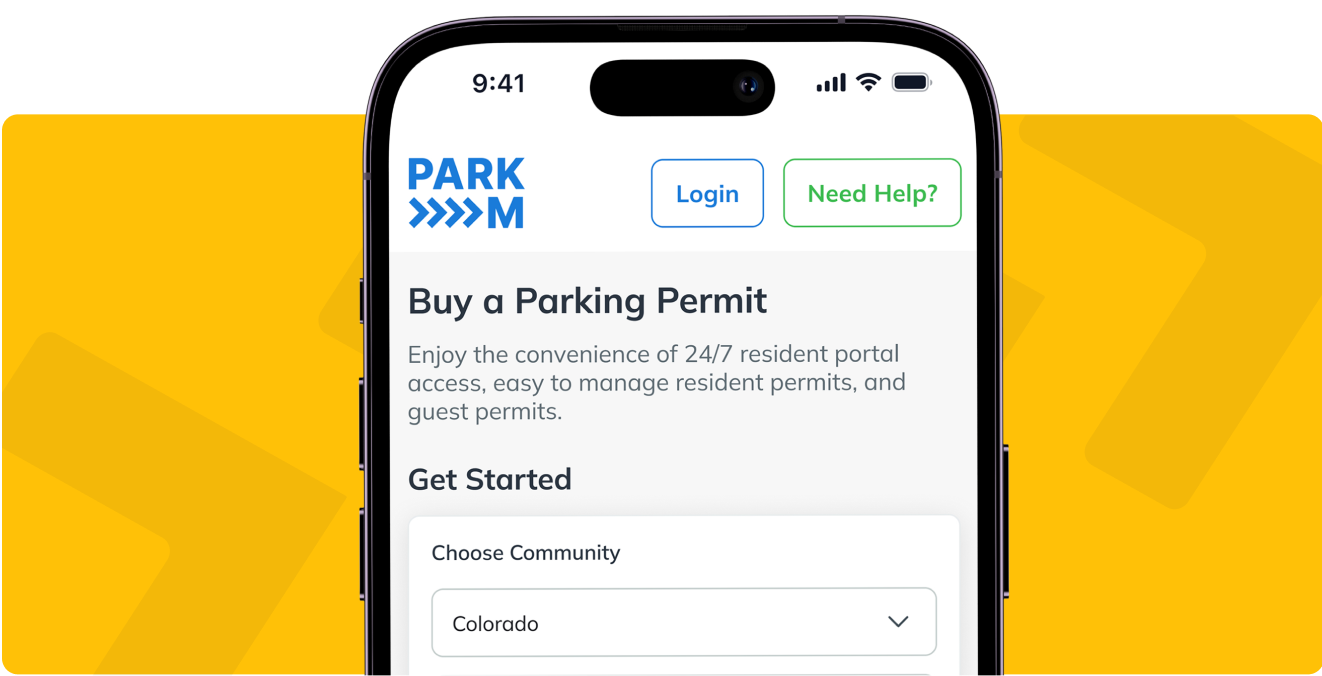
Smart parking solutions are systems that use software, and sometimes sensors or cameras, to decide who can park where, take payment, and keep a live record of every vehicle on a property. For an apartment community, whether one is worth it depends on three things: how much pressure your parking is under, what the system costs the property, and who deals with the fallout when something goes wrong.
Most of what gets sold as smart parking was built for city streets, garages, and office lots, where the problem is finding an open space. Apartment communities have a different problem. Residents come home to find someone in their assigned space, a guest’s car has been in the lot for nine nights, and nobody in the leasing office can say who it belongs to. This guide covers the whole category, then focuses on what matters at a multifamily property.
Key takeaways
- Smart parking solutions replace stickers, hang tags, and manual lot walks with a digital record of which vehicles are allowed to park.
- City and garage systems rely on sensors and pay stations. Apartment communities mostly need permits, guest limits, and enforcement records, and those can run on software alone.
- Pricing follows one of three models: buying hardware, paying a monthly software fee, or a resident-funded model where the vehicle owner pays and the property pays nothing.
- The real drawbacks are resident pushback, plate misreads, and wrongful tows. Ask every vendor how it handles each one before you sign anything.
- A system earns its place when parking causes regular complaints, guest parking spills into resident spaces, or your team spends hours each week policing the lot.
What are smart parking solutions?
Smart parking, sometimes called digital parking, is an umbrella term. It covers any system that replaces manual parking management (paper permits, window stickers, a clipboard and a flashlight) with technology that identifies vehicles, tracks how spaces are used, or takes payment automatically.
Five kinds of systems sit under the label, and they solve different problems.
| Type of smart parking system | What it does | Where it fits best | What gets installed |
|---|---|---|---|
| Occupancy sensors | Detect whether each space is empty or taken | City streets, garages, large public lots | A sensor in or above every space, plus network gateways |
| Parking guidance | Signs and apps that send drivers to open spaces | Garages, airports, stadiums | Signs, plus the sensors or cameras that feed them |
| Cashless payment | Takes payment by card, phone, or QR code instead of coins | Paid public and commercial parking | Pay stations, or just signs with a QR code |
| License plate recognition (LPR) | Reads plates and checks them against a list of authorized vehicles | Enforcement anywhere, apartment lots included | Fixed cameras, or an app on a phone with no fixed hardware |
| Digital permits | Make the license plate the permit, so there is no sticker or hang tag | Apartment communities, campuses, workplaces | Nothing beyond signs telling residents and guests where to register |
Much of what you will read about smart parking describes the first two. At an apartment community, the last three do most of the work. For the detail on the plate-reading piece, see our guide to how license plate recognition works, and for what a property team can see once every plate is on record, see parking lot monitoring.
How does smart parking work at an apartment community?
Residential parking solutions are simpler than the city version. The plate is the permit, so the heart of the system is one list of authorized vehicles that the office, the residents, and the tow company can all check. At a multifamily property it usually runs in four parts.
- Residents register online. A resident enters their plate from a phone or computer, with no app to download, and the permit is live as soon as it is issued. ParkM also asks for the last six digits of the VIN, for a reason covered under the drawbacks below.
- Guests get a permit the same way. A resident can buy one for a visitor, or the guest can buy it directly by scanning the QR code on a parking sign. The property decides how many guest permits each unit gets and how many nights in a row a guest can stay.
- The office sees everything in one place. A property manager portal shows every active permit, the unit it belongs to, and every warning or tow, each with a timestamp.
- Your enforcement partner checks plates from a phone. The tow or boot company the property already works with uses an app that reads each plate and shows whether the car has a valid permit. Nothing is mounted in the lot, and the property sets the enforcement terms with that company directly.
What changes for the leasing office is mostly what stops happening. Nobody hands out stickers or replaces lost hang tags, and when someone is parked in an assigned space, there is a record showing whose car it is, or that it has no permit at all.
If the permit side is the part you are weighing, our guide to virtual parking permits walks through enrollment, renewals, and move-outs step by step.
What are the benefits of a smart parking system for property managers?
The benefits land on both sides of the counter: your team gets hours back, and residents get a parking setup they can manage themselves.
- Registration, guest permits, vehicle swaps, and cancellations happen online at any hour, so they stop landing on the front desk, including the guest who is arriving on Friday night.
- Guest parking stays guest parking. Nightly caps and limits on consecutive nights keep a “guest” from quietly becoming an extra resident with no permit. Our guide on how to stop guest parking abuse goes further on setting those limits.
- A dispute has a record behind it. When a resident disputes a warning or a tow, the timestamped record shows what was checked and when. That protects your leasing team as much as the resident.
- You see what you cannot see today. Once every vehicle is tied to a unit, cars that belong to no one on the lease stand out, and so do abandoned vehicles and expired registrations.
- Parking earns revenue as an asset you already own. The property already builds, lights, and maintains it. Charging for reserved spaces, covered spaces, or extra vehicles turns part of that cost into ancillary income with no construction involved. We cover the options in generating parking revenue without raising rent.
- Residents get a permit from their phone, a guest permit without waiting for office hours, and a reminder by email or text before a permit expires.
For a closer look at the day-to-day problems this removes, see the permit headaches software solves, or the full list of ParkM benefits for property teams and residents.
What are the drawbacks of smart parking systems?
Every parking system has trade-offs. These are the ones worth weighing, with the question to put to any vendor about each.
Up-front cost and installation
Sensor, guidance, and camera systems need hardware installed and maintained, and that cost usually sits with the property. Software-based permits and phone-based plate reading avoid most of it. Ask what has to be installed, who owns it, and who pays when it breaks.
Plate misreads
License plate recognition is reliable but not flawless. A reader can take an I for a 1 or an O for a 0, and in an enforcement setting a misread can mean the wrong car gets towed. Ask what the system checks besides the plate before a tow happens. At ParkM, the enforcement partner verifies the last six digits of the VIN against the vehicle before towing it, which is a second check against exactly this kind of misread. If a vehicle is still wrongly towed, ParkM covers the cost, with no cap.
Residents who do not want to pay for parking
If parking has always been free, some residents will object to paying for it. Plenty of communities have handled this once already, with utility billing: the new charge applied to new move-ins, and existing residents were left alone. The same approach carries over to parking.
ParkM calls it grandfathering. Existing residents are enrolled free, only new move-ins pay, and the rules do not change for anyone in the middle of a lease. The property can chooses whether a grandfathered resident stays free until their lease renews or not. You can see where it fits in a rollout in how ParkM works.
A learning curve for some residents
Some residents, often older ones, will not want to register a car online. Two things help: nothing to download, and someone other than your leasing team answering their questions. ParkM’s US-based support team handles resident and guest questions directly, so “how do I register my car?” goes to ParkM rather than to your front desk. Vanessa D., at Parkwood Plaza and Continental Court (AMC), described the staff side of that support this way: “If any of our staff ever has a question ParkM support is able to respond to us within a 10-minute time frame.”
Getting locked in
Some systems come with multi-year contracts, or with hardware the property has paid for and cannot take with it. Ask how you leave and how much notice you need to give. ParkM has no contract and needs 30 days’ notice.
How much do smart parking solutions cost?
Prices across the category follow three models, and the model tells you more than any single number.
- Hardware, bought or leased. Sensor, guidance, and camera systems usually mean equipment and installation up front, then maintenance and a software subscription on top.
- A monthly software fee. The property pays the vendor a recurring fee, per community or per unit, and decides separately whether to pass any of it on to residents.
- A resident-funded model. The property pays nothing. Residents and guests pay for their permits, and the vendor shares that revenue with the property.
ParkM uses the third model. There is no cost to the property and no monthly billing to the property: the vehicle owner pays for the permit. The property sets what permits cost at its own community, and ParkM shares the permit revenue with the property. Parking signs with QR codes are included, and any extra signage comes out of the parking revenue rather than an invoice.
For 100% tax credit properties, where residents cannot be charged to park their first vehicle on site, ParkM runs a First Car Free model. Each resident’s first vehicle parks free, and permits apply to guests and, if the property chooses, to additional vehicles.
A resident-funded model does not suit everyone. An association that would rather pay one fee than ask owners to pay per permit is usually better served by a flat fee, or by a program limited to guest parking.
Are smart parking solutions worth it?
Density matters less than how much parking is costing your team today. A smart parking solution tends to be worth it when several of these are true:
- Residents regularly find someone else in their assigned or reserved space.
- Guest parking fills up overnight, or the same “guest” car is there most nights.
- Your team hands out, replaces, or checks stickers and hang tags.
- You have had a tow dispute, or a resident towed who should not have been.
- You suspect there are vehicles on site that belong to no one on the lease.
- Parking calls reach your team after hours or first thing every morning.
- The property has spaces it could charge for, such as covered, reserved, or extra-vehicle spaces, and does not.
It is harder to justify when parking is plentiful, nobody competes for spaces, and guests are rare. If residents can always find a space and you have not heard a parking complaint in months, there is little for a system to fix, and a new charge will read to residents as a fee for nothing.
The other half of the answer is cost. A system the property pays for has to earn back its fee in saved hours and fewer disputes, so it is worth measuring how much time parking management takes your team first. A resident-funded system starts at no cost to the property, which leaves one real question: will your residents accept it? That is what grandfathering is for.
Seven questions to ask before you choose a smart parking solution
Whichever vendor you talk to, these seven answers tell you most of what you need to know. They are also the questions your regional or asset manager will ask, so get the answers in writing.
- Who pays, and does the property ever get a bill? Ask about setup fees, monthly fees, hardware, signage, and minimums.
- What has to be installed, and who maintains it?
- Who enforces? Check whether you keep your current tow or boot company, and who sets the terms. ParkM does not tow. Your enforcement partner does, on terms the property sets with them.
- What happens if a car is towed by mistake? Ask whether the vendor verifies a vehicle before a tow, and what it pays if that check fails.
- How are existing residents handled? If the answer is that everyone starts paying on day one, expect the pushback to land in your office.
- Who answers residents’ questions? If it is your leasing team, the system has moved the work rather than removed it.
- How do you leave? Ask about contract length and the notice period.
If you would like ParkM’s answers to all seven for your own community, book a demo and put them to us directly.
Frequently asked questions about smart parking solutions
Do residents need to download an app?
Not with ParkM. Residents and guests register and buy permits online from a phone or computer, with nothing to install. It is still worth asking any vendor, because some smart parking systems do require an app, and a download is one more step for a resident who is already skeptical and one more thing for the leasing office to explain.
Does a smart parking system replace our tow company?
No. A permit system tells your enforcement partner which vehicles are authorized. It does not tow anything. With ParkM, the property keeps its own tow or boot company and sets the enforcement terms with them directly. Their drivers check plates in ParkM’s app before acting, and every action is timestamped. A property with no enforcement partner can get a referral from ParkM’s preferred vendor list.
Can we still make exceptions for staff and vendors?
Yes. The property can put staff, vendors, and anyone else it chooses on a no-tow list, and it can block a plate when it needs to, for example after an eviction. The property also sets the rules, including permit types, limits per unit, and guest caps, so the system enforces your parking policy instead of replacing it.
Is smart parking only worth it at large urban properties?
No. Density helps, but it is not the test. A suburban community with assigned spaces, overnight guest pressure, or a tow dispute in the past year has the same problems as a downtown one. ParkM is a good fit for communities of 100 units or more, and it works with properties of any size.
What do we need to get started?
A unit directory or rent roll, and a launch date. ParkM assigns a launch coordinator, supplies pre-written notices for residents, and trains your staff and your enforcement partner. The rent roll also tells ParkM which residents to grandfather, because it carries each lease’s end date.