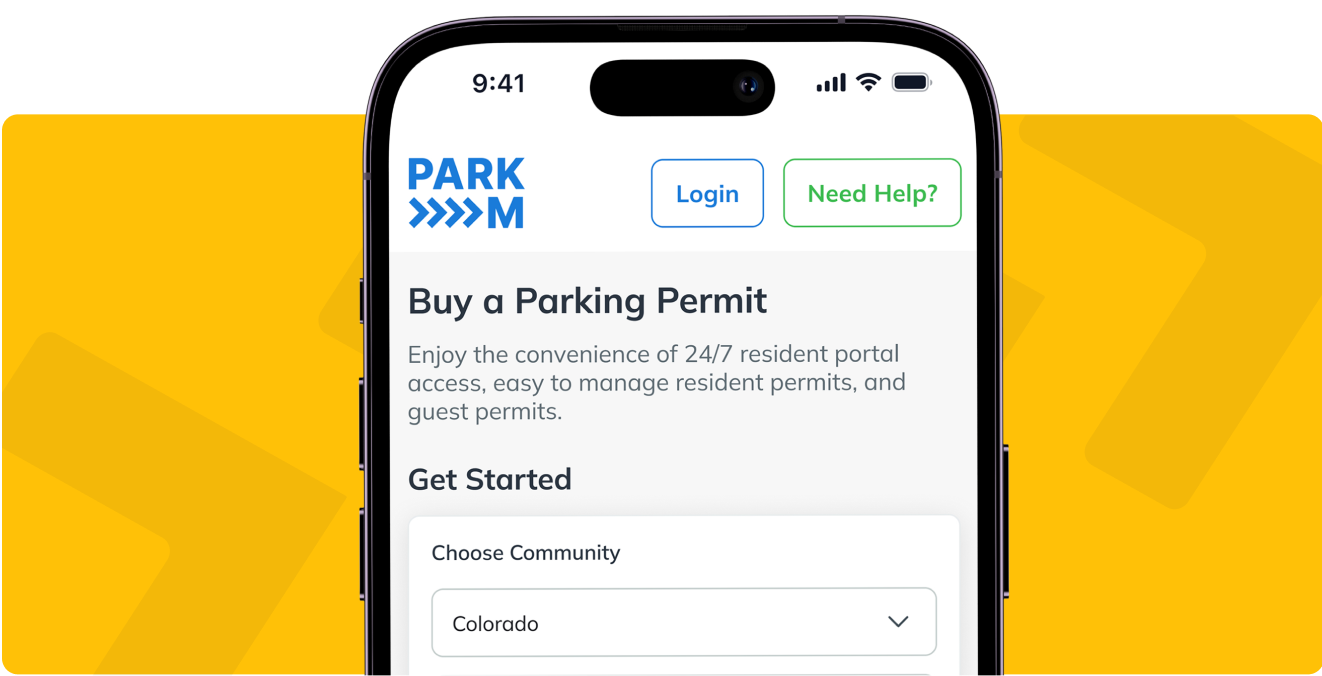
Contactless parking payment means a driver pays for parking from a phone or computer, with no cash, no check, and no card handed across a counter. At an apartment community it means something more specific: residents and guests buy parking permits online, the license plate becomes the permit, and nobody collects parking money at the leasing office.
Search the term and most of what comes back is city street parking: meter zones, pay-by-phone apps, municipal parking offices. That is a different job. A city sells an hour at a curb to whoever pulls up. An apartment community decides which vehicles belong in its lot every night, for residents it knows by unit number. This guide covers the apartment version, for the property manager deciding whether to make the switch.
Key takeaways
- Contactless parking payment at an apartment community means residents and guests pay for permits online, and each paid permit is tied to a license plate.
- It takes cash, checks, paper permits, and after-hours guest pass requests out of the leasing office.
- City pay-by-phone apps sell time at a curb. Apartment systems manage who is allowed in the lot, so the two are built differently.
- With ParkM, there is no cost to the property and no monthly billing to the property. The vehicle owner pays.
- Before you switch, ask three things: who pays, how fast a payment becomes a permit, and who answers residents when something goes wrong.
What is contactless parking payment?
Contactless parking payment is any way of paying for parking that happens online rather than in person. The driver enters a vehicle and a payment method on a phone or computer, pays, and the parking is authorized without a ticket, token, or permit changing hands.
The phrase caught on when nobody wanted to pass cash or a check across a desk. Apartment communities have kept it for a more practical reason: it takes parking money out of the leasing office.
At an apartment community, the old way is familiar. A resident comes to the office during business hours, fills out a form, pays by check, and leaves with a sticker or a hang tag. A host who is expecting a guest comes back for a paper pass, if the office is open. Someone on the team keeps the list, and the list goes out of date the day a resident sells a car.
The contactless version replaces all of that with one online record. The resident registers the vehicle and pays. The plate goes onto the community’s list of authorized vehicles. The property’s enforcement partner checks plates against that list. There is nothing to print, stick on a windshield, or replace, which is why this is usually called a virtual parking permit.
City parking payment vs. apartment parking payment
The term covers two different problems. Separate them before you compare vendors, because a system built for one does a poor job of the other.
| City street and garage parking | Apartment community parking | |
|---|---|---|
| What the driver buys | Time in a zone, usually by the hour | A permit to park at one community, usually monthly |
| Who is buying | Anyone passing through | Residents on the lease, and their guests |
| What gets checked | Whether a session is active in that zone | Whether the plate is on the community’s authorized list |
| Who checks | Parking enforcement officers | The property’s own tow or boot company |
| Who sets the rules | The city | The property: permit types, prices, and guest limits |
| What the manager needs | Nothing, the city runs it | A live list of who is parked on the property, and why |
The last row is the one that matters. On a city street, the payment is the whole transaction. At an apartment community, the payment is how a vehicle gets onto the authorized list, and that list is what your team and your enforcement partner work from.
How contactless parking payment works at an apartment community
Here is how it runs with ParkM, from setup to enforcement.
- The property sets the rules. You choose the permit types (resident, second vehicle, guest, reserved), how many permits a unit or leaseholder can hold, how many guest permits a unit can use, and what each permit costs.
- Residents register online. A resident goes to parkm.app from a phone or computer, enters the license plate, and pays. There is no app to download. The permit is active as soon as the purchase goes through.
- Permits renew or expire on schedule. Resident permits renew automatically each month, and before a permit expires, ParkM sends a reminder by email and text.
- Guests pay without the office. A resident can buy a guest permit for a visitor, or the guest can buy one directly by scanning the QR code on the community’s parking signs. This is how ParkM handles guest parking.
- Your enforcement partner checks the plate. Your tow or boot company uses ParkM’s enforcement app to check plates from a smartphone, and a paid plate shows as permitted. No cameras or other equipment are installed on the property.
- You see everything in one place. The property manager portal shows every active permit, every vehicle, and every enforcement action, with revenue broken down by permit type.
ParkM processes permit payments through Stripe, a third-party payment processor, so your team never handles residents’ card details. ParkM is designed to work alongside the tools property teams already use, and the three-part version of the flow (residents and guests, the property manager, enforcement) is laid out on how ParkM works.
What contactless payment takes off the leasing office’s plate
Most properties do not switch for the payment itself. They switch for what stops happening at the front desk.
- Cash, checks, and card numbers for parking stop coming through the office. Residents and guests pay online.
- There are no stickers or hang tags to hand out, lose, or reissue when a resident changes cars, because the plate is the permit.
- Guest permits stop being an office-hours problem. Guests tend to arrive in the evening and on weekends, and the host or the guest can buy a permit without calling anyone.
- When a car looks out of place, your team can look up the plate in the portal and see which unit it belongs to.
- Resident and guest questions about payments and permits go to ParkM’s US-based support team rather than to your leasing staff.
Guest limits are where most of the control sits. A cap on guest permits per unit, and on consecutive nights, is the main tool to stop guest parking abuse, and it only works when guests pay through the same system residents do.
One property manager put it this way:
“Our parking issues and complaints have improved by a long shot! We are so thankful for the fast customer service that we receive through ParkM.”
Vanessa D., Parkwood Plaza & Continental Court, AMC
What residents and guests get
A parking program only works if residents accept it, so the resident side matters as much as the office side.
Residents can buy and manage a permit at any hour, from a phone or a computer, without downloading anything. From their account they can update vehicle details, swap a vehicle, change their payment method, and cancel a permit at any time with no cancellation fee. Any change to the account triggers an email and text alert.
Not every resident is comfortable online, and that is usually the first worry a property manager raises. Two things help. There is no app store step, and residents who get stuck have a support team to turn to that is not your front desk. ParkM answers resident and guest questions directly. See how the resident side is set up on resident parking solutions.
Guests get the simplest version. They scan the code on a sign, enter the plate, and pay, without tracking down the resident they are visiting or waiting for the office to open.
Does contactless parking payment cost the property anything?
With ParkM, no. There is no cost to the property and no monthly billing to the property. The vehicle owner pays: residents and guests buy their permits, and ParkM is funded from those purchases. ParkM shares that revenue with the property, and the property sets what each permit costs at its own community.
A few terms matter as much as the cost:
- There is no contract. The property can leave with 30 days notice.
- Existing residents do not have to start paying mid-lease. With grandfathering, residents already living at the community are enrolled free and only new move-ins are charged, so the rules do not change mid-lease for anyone who already lives there.
- 100% tax credit properties, which cannot charge residents to park one vehicle onsite, run on a First Car Free model. ParkM charges only for guest parking and, if the property chooses, additional resident vehicles.
- Parking signs carrying the property’s QR code are included. Extra signs are deducted from revenue, never invoiced.
One honest limit. The model is built for rental communities, where residents and guests pay for their own permits. ParkM does not bill an association a monthly fee on behalf of its members, so an HOA that wants one invoice for everyone should ask about the alternatives, such as permitting guest parking only.
What to ask before you choose a parking payment system
These questions separate a system that takes payments from one that runs your parking. Ask every vendor, ParkM included.
| Question to ask | ParkM’s answer |
|---|---|
| Who is billed, the property or the driver? Is there a monthly fee, a setup fee, or a minimum? | The driver. There is no cost to the property and no monthly billing to the property |
| How fast does a payment become a valid permit? | Immediately. A permit is live the moment it is bought, so a resident who has paid is not waiting to be safe from a tow |
| Do residents or guests have to download an app? | No. Everything runs in a browser at parkm.app |
| Can a guest get a permit at 10pm on a Saturday without calling anyone? | Yes. The resident or the guest buys it online, including from the QR code on your signs |
| Who answers a resident whose card is declined, or who registered the wrong car? | ParkM’s support team, not your leasing office |
| How does your enforcement partner confirm a plate is paid before towing? | They check it from a smartphone. Signup also records the last six digits of the VIN, which the tow operator verifies against the vehicle before towing, so a misread plate can be caught first. Every enforcement action is timestamped |
| What happens to existing residents on launch day? | With grandfathering, they are enrolled free and only new move-ins pay |
| What does it take to leave? | 30 days notice. There is no contract |
If your current setup sends most of these back to the front desk, that is the case for switching. To see it with your own permit types, guest limits, and lot, book a demo.
Frequently asked questions
Is contactless parking payment the same as a parking app?
Not always. City systems usually run through an app the driver downloads. With ParkM, residents and guests use parkm.app in the browser on a phone or computer, so there is nothing to install and nothing to update.
Can residents still pay for parking by cash or check?
No. ParkM is digital by design: the plate is the permit, and payment happens online. That is the point for the leasing office, which stops handling parking money altogether. Residents who need help with the online steps can go to ParkM’s support team.
Can a resident cancel a parking permit?
Yes. A resident can cancel from their account at any time, with no cancellation fee. Payments already made for a billing cycle are not refunded, as ParkM’s terms set out, so cancelling stops the next charge rather than returning the last one.
Do we have to start charging residents for parking?
Not all at once. With grandfathering, residents already living at the community are enrolled free and only new move-ins pay, so nobody’s arrangement changes mid-lease. You also decide which permit types exist and what each one costs.
Who handles residents’ payment details?
ParkM processes payments through Stripe, a third-party payment processor. Residents and guests enter their own card details online, so your team never collects or stores them.