
Key Takeaways:
- Property parking management routinely eats several hours of staff time every week.
- Most of that time goes to repetitive administrative work, not resident service, which is exactly the kind of task software is built to absorb.
- Automated parking permit management replaces spreadsheets and paper logs with self-service tools that cut office visits and phone calls.
- Across a portfolio, the hours saved at each property compound into a measurable gain in staff capacity.
- The biggest time savings usually come from the highest-volume tasks first, guest registration and permit renewals, not enforcement.
Property parking management rarely tops a leasing team’s list of biggest time drains, at least not until someone actually measures it. Maintenance requests, leasing tours, and resident renewals usually come to mind first when property managers are asked where their week goes. But when onsite teams track their own workflows, parking management shows up again and again: not as one large task, but as dozens of small interruptions that never fully stop.
Issuing a permit. Verifying a guest pass. Fielding a call about a vehicle in the wrong spot. Reissuing a lost hangtag. Individually, none of these tasks take much time. Added together across a week, though, they take a real bite out of a leasing team’s schedule, time that isn’t going toward leasing, renewals, or resident retention.
This guide breaks down where that time actually goes, what it costs a property or portfolio in real hours, and how the right parking permit management tools give that time back to the team that needs it most. Along the way, we’ll look at what onsite teams commonly get wrong when trying to fix it, and what separates a parking management system that actually saves time from one that just digitizes the same paperwork.
The Time Nobody’s Tracking
Most communities don’t track staff hours spent on parking the way they track hours spent on leasing or maintenance. There’s no line item on a timesheet for “permit administration” or “guest parking disputes.” Because parking-related tasks are scattered throughout the day instead of blocked into one activity, they’re easy to underestimate, and even easier to leave off a workload assessment entirely.
Where Parking Time Hides in a Normal Day
A leasing agent might spend five minutes updating a resident’s vehicle information, ten minutes on a phone call about an unauthorized vehicle, and another few minutes emailing a visitor parking pass, all before lunch, and rarely think of it as “parking work.” It just feels like part of the job.
Why This Adds Up Across a Team
Multiply those interruptions across a week, a team, and a portfolio, and the number gets significant fast. A single five-minute task is invisible. Fifteen or twenty of them a day, spread across a leasing team, is effectively a second, unstaffed job layered on top of everyone’s regular workload.
Where the Hours Actually Go
When property teams audit their own workflows, the time spent on parking tends to cluster around eight recurring tasks: issuing and renewing permits, registering guests, verifying plates, fielding unauthorized-vehicle complaints, replacing lost permits, coordinating enforcement, resolving disputes, and compiling reports. None of these are complicated on their own. All of them are repetitive, and none of them scale well without help.
The Recurring Task List
- Issuing and renewing resident permits
- Registering and re-registering guest vehicles
- Verifying license plates against permit records
- Answering phone calls and emails about unauthorized vehicles
- Replacing lost or damaged hangtags and stickers
- Coordinating with towing or enforcement vendors
- Investigating and resolving parking disputes between residents
- Pulling parking data or incident history for ownership reports
Common Mistakes That Make It Worse
The property teams who spend the most time on parking tend to share a few habits in common:
- Relying on a single spreadsheet with no backup, so any error, deletion, or version conflict becomes a fire drill.
- Not requiring guest registration in advance, which pushes every visitor approval into a live phone call or office visit.
- Issuing permits with no expiration date, so outdated records pile up instead of self-clearing.
- Treating enforcement as reactive, something that only happens after a complaint, instead of a routine part of daily operations.
None of these mistakes are unusual. They’re the default outcome of managing parking with tools that were never built for it.
Putting a Number on It
Every community is different, but a rough estimate helps illustrate the scale. Consider a mid-sized property handling the task volumes below.
| Task | Weekly Volume | Time per Task | Weekly Total |
|---|---|---|---|
| Permit requests / updates | 10 | 5 min | 50 min |
| Guest registrations | 15 | 3 min | 45 min |
| Unauthorized vehicle calls | 8 | 10 min | 80 min |
| Lost permit replacements | 3 | 8 min | 24 min |
| Dispute investigations | 2 | 20 min | 40 min |
| Total | ~239 min (≈4 hrs) |
What This Looks Like Across a Portfolio
That adds up to roughly four hours a week, about half a workday, spent solely on parking administration at a single property. Multiply that across a portfolio, and the impact grows fast: a regional manager overseeing ten communities loses the equivalent of a full work week every seven days to parking paperwork and phone calls, time that could otherwise go toward leasing, resident retention, or capital planning.
These figures are illustrative, not a benchmark, but they reflect what onsite teams consistently report once they actually track the work: parking administration is rarely a five-minute task. It’s a steady stream of five-minute tasks that never lets up.
Why Manual Parking Management Costs More Than Time
Time is the most visible cost of manual parking management, but it isn’t the only one. Spreadsheets, paper permits, and handwritten visitor logs introduce problems that compound over time, and those problems tend to surface in ways that have nothing to do with a clock.
Human Error and Data Decay
Duplicate permits, mistyped plates, and outdated records are common when data lives in disconnected spreadsheets. Every manual entry is a chance for the record to drift further from reality, and nobody notices until an enforcement dispute forces a manual audit.
Staff Turnover and Lost Institutional Knowledge
Manual processes are hard to hand off. When a leasing agent leaves, institutional knowledge about “how parking works here”, which spreadsheet is current, which residents have exceptions, how guest passes are actually tracked, often leaves with them.
Inconsistent Enforcement and Resident Trust
Without a single source of truth, different staff members may apply rules differently, which residents notice and resent. Parking demand isn’t shrinking either: according to the U.S. Bureau of Transportation Statistics, 59 percent of U.S. households now own two or more vehicles, up sharply from a few decades ago. Most communities are managing more vehicles per household than their parking lots were originally designed for, which makes consistent enforcement more important, not less.
For a closer look at how these problems show up operationally, see our related post on manual vs. digital parking management, and how unresolved parking issues connect to the hidden cost of apartment parking complaints.
How Parking Management Systems Give the Time Back
Permit issuance, guest registration, plate verification, enforcement coordination: these are exactly the kind of repetitive, rules-based tasks that software handles well. That’s the core promise of modern parking management systems. They don’t just organize parking data; they remove the manual work altogether.
What Gets Automated
- Permit issuance and renewal: residents register vehicles and manage their own permits online, without a trip to the leasing office.
- Guest registration: visitors are registered digitally in advance, cutting down on calls to approve or explain guest parking.
- Vehicle verification: digital permits tied to license plates let staff confirm authorization instantly, on any device, instead of walking the lot with a clipboard.
- Enforcement coordination: integration with license plate recognition (LPR) technology flags unauthorized vehicles automatically, reducing reactive phone calls.
- Reporting: violation history, permit counts, and occupancy data are available on demand, instead of requiring staff to compile them manually for ownership.
Lessons From Communities That Made the Switch
Property teams that move from manual to digital parking management consistently report the same pattern: the biggest time savings show up first in guest registration and permit renewals, not enforcement. That’s because these are the highest-volume, lowest-complexity tasks, exactly the ones that once made up the bulk of staff interruptions. Enforcement gets easier too, but usually only after the underlying data (knowing who’s authorized and who isn’t) is already accurate.
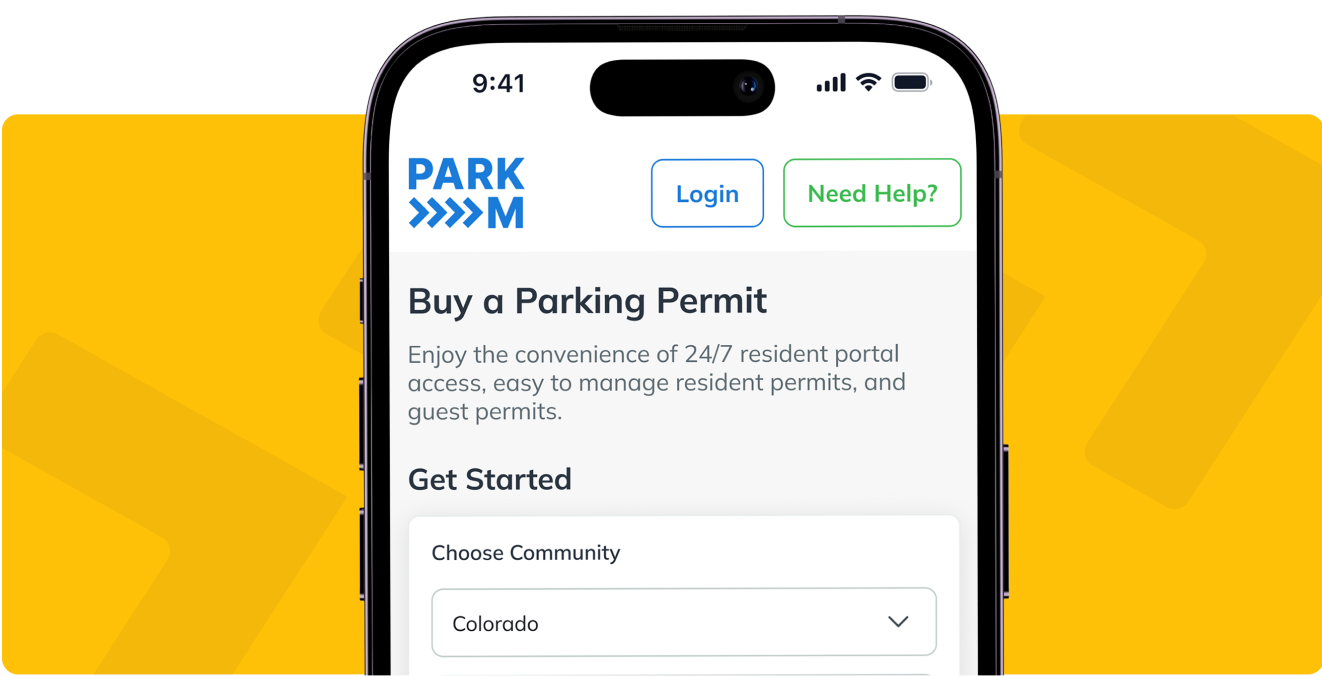
See how ParkM works for a closer look at what this looks like in practice.
What to Look for in a Parking Management System
Not all parking management system companies solve the same problems, and the right fit depends on what’s actually consuming your team’s time.
Core Features That Save the Most Time
- Fully digital permit management: no hangtags or stickers to print, mail, or replace.
- Self-service resident and guest portals: the fewer requests that require staff involvement, the more time comes back to the team.
- License plate–based verification: eliminates the need to physically check for a sticker or permit.
- Enforcement and LPR integration: connects parking rules to real-world monitoring, instead of relying on staff to patrol the lot.
- Portfolio-level visibility: for regional and multi-site managers, a system that reports across properties, not just one at a time.
- Straightforward onboarding: a platform that’s simple for both staff and residents to adopt, since a tool nobody uses doesn’t save anyone time.
Questions to Ask Parking Management System Companies
- How much staff time does onboarding take, and who handles resident communication during the switch?
- Can residents and guests self-serve permits and registration without calling the office?
- Does the system integrate with existing enforcement or LPR vendors, or require switching providers?
- What does reporting look like for a single property versus an entire portfolio?
For more on what property managers should prioritize day to day, our resources for property managers page covers additional operational context. For broader property management best practices beyond parking specifically, IREM is a good industry resource.
Estimating Your Own Time Savings
Before evaluating software, it’s worth spending a week doing what most communities never do: tracking parking-related tasks as they happen.
A Simple Framework
- How many permit requests, renewals, or updates does your team handle weekly, and how long does each take?
- How many guest parking registrations or approvals come through phone, email, or in person?
- How many calls or emails involve unauthorized vehicles or parking disputes?
- How much time is spent compiling parking data for ownership or regional reporting?
Best Practice: Track Before You Buy
Multiply the answers by an average time-per-task, and you’ll have a realistic, property-specific estimate of how much staff capacity is tied up in parking administration, and how much of it could be reclaimed with the right system in place. Teams that skip this step often end up choosing a system based on features rather than on the tasks actually costing them time.
Parking management often gets treated as a background task, something staff handle in the gaps between bigger priorities. But those gaps add up. The time spent issuing permits, verifying guests, and resolving disputes is real staff capacity, and in most communities, it’s capacity that could be redirected toward leasing, resident retention, and the work that actually grows the business.
As the National Apartment Association has emphasized, resident experience remains a top priority industry-wide, and parking is one of the few resident touchpoints that happens every single day. Property parking management doesn’t have to be a manual, hour-by-hour drain. With the right parking management system in place, most of that administrative work happens automatically, giving onsite teams their time back.
Frequently Asked Questions
How much time do property managers spend on parking?
It varies by community size and parking demand, but property teams commonly spend several hours per week on parking-related administration, permit issuance, guest registration, enforcement calls, and dispute resolution. For a portfolio of multiple communities, that time can add up to the equivalent of a full work week or more across a regional manager’s properties.
How can apartment communities automate parking?
Apartment communities automate parking by replacing manual, paper-based processes with a digital parking management system. This typically includes self-service permit registration for residents, digital guest parking passes, license plate-based verification, and integration with enforcement or LPR technology, so staff no longer have to manually track, verify, or reissue permits.
How do I reduce parking administration?
The most effective way to reduce parking administration is to eliminate manual permit tracking. Moving from spreadsheets, hangtags, and paper logs to a digital parking permit management platform lets residents manage their own information, reduces phone calls and office visits, and gives staff a single, accurate source of truth instead of scattered records.
How can I save staff time managing parking?
Staff time is saved primarily by shifting repetitive tasks, permit issuance, guest approvals, plate verification, from manual processes to self-service technology. A parking management system handles these tasks automatically which provides a seamless experience for everyone.
What is a parking permit management system?
A parking permit management system is software that lets property teams issue, track, and enforce parking permits digitally, typically tied to a resident’s license plate rather than a physical sticker or hangtag. It replaces manual spreadsheets and paper logs with a single, searchable record that staff, residents, and enforcement partners can all reference.
How can parking management improve resident retention?
Parking is one of the few interactions residents have with a property every single day. Unresolved parking problems compound into a broader impression that a community is poorly managed. Consistent, well-enforced parking policies reduce daily friction, which supports the same resident experience goals that drive lease renewals.
About ParkM
At ParkM, we help apartment communities simplify parking with digital resident permits, guest parking management, compliance tools, and enforcement solutions designed specifically for multifamily housing.
Whether you manage one property or an entire portfolio, ParkM helps reduce the time your team spends on parking administration which gives staff more hours back for residents, not paperwork.
Ready to see how much time your team could save on parking management?
Schedule a personalized demo to find out how ParkM can help your team reclaim hours lost to manual parking administration.